
Eleven Uncomfortable Truths About Your Mind, Backed by Cognitive Science
Eleven evidence-backed truths about how your mind actually runs — from 47% mind-wandering to the prediction machine in your skull — each traced to a named study, not a self-help slogan.

Chinese version: 中文版
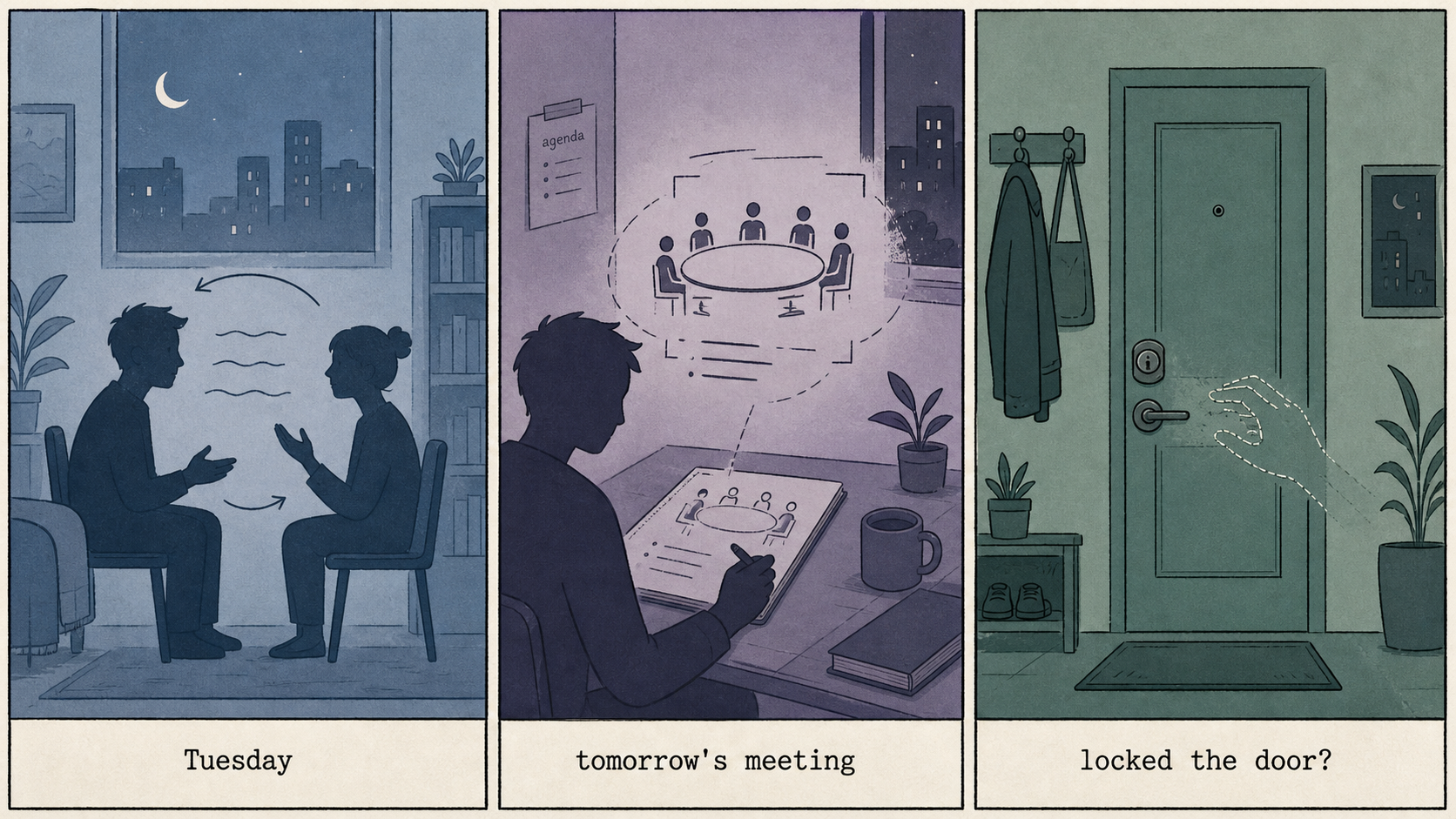
It is two in the morning. Your body should have surrendered to sleep an hour ago, but your mind is still replaying a conversation, drafting tomorrow, wondering whether you locked the door. Then, for about half a second, something shifts: you notice the thoughts instead of drowning in them. That half-second is the most important moment of your day, and most of us miss it.
This episode walks through eleven evidence-backed truths about how your mind actually runs — one for each of the eleven chapters of The Modeling Mind. Every claim below traces back to a named study, an actual journal, an actual year. No “studies show,” no self-help hand-waving. Here is what is running underneath your everyday life.
The eleven uncomfortable truths
1. You have spent roughly half your waking life somewhere your body was not
In 2010, Harvard psychologists Killingsworth and Gilbert pinged 2,250 people at random moments and asked what they were doing, thinking, and feeling. Published in Science, the result: minds were wandering 46.9% of the time — almost half — regardless of the activity, and mind-wandering predicted unhappiness across the board.
2. Your brain is not a thinking machine — it is a prediction machine
Structurally, it is closer to a large language model than it feels. Your brain runs a modeling engine that predicts your perception, emotions, and decisions before the conscious you catches up. The book flags every parallel as literal or analogy — this one is an architecture claim. The difference between you and a predictive model is not the architecture; it is that the model gets to stop training, and you never do.
3. You have never seen reality — only the desktop icons
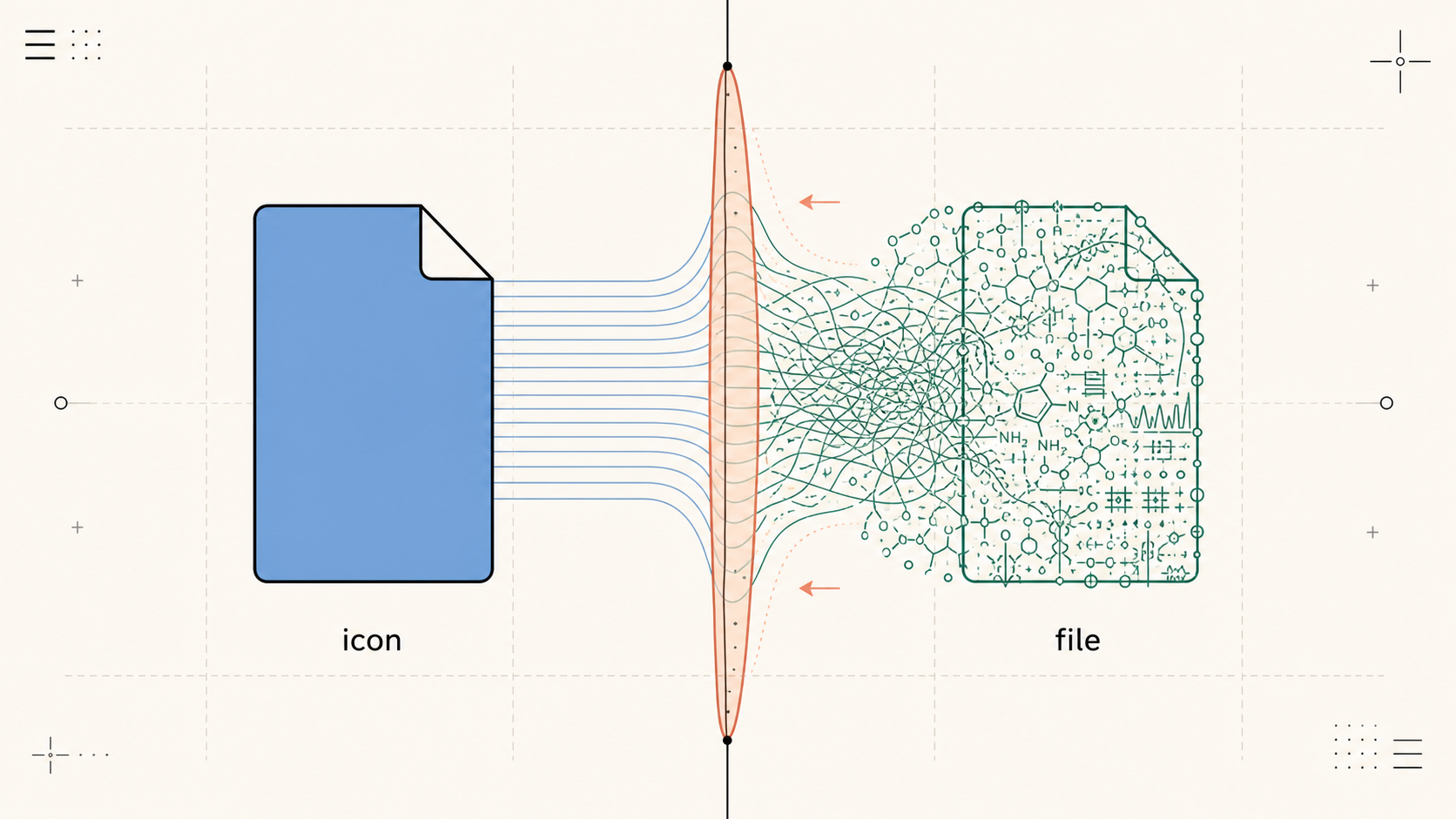
What you experience as the world is a layered render, polished by chemistry and pattern recognition until your mind calls it real — the way a user mistakes an icon for the file. Donald Hoffman at UC Irvine calls this the interface theory of perception; his fitness-beats-truth theorem shows mathematically that evolution selects for useful interfaces, not accurate ones. You see what keeps you alive, not what is true.
4. Two processes share your skull, and most days only one talks
One is the narrator, generating the running stream you call me. The other is the observer, which can watch the show without narrating it. This maps onto established frameworks — cognitive defusion in Acceptance and Commitment Therapy, and the capital-S Self of Richard Schwartz’s Internal Family Systems. A twenty-second experiment: notice your breathing without changing it, then ask who is noticing. Whatever answers is the observer.
5. You can run an entire life on autopilot and never be behind the wheel
The book calls it NPC mode, borrowed from the driver-asleep problem: the car holds the lane perfectly whether or not anyone is conscious. In 2007, Smallwood and Schooler found something counterintuitive — mind-wandering itself does not degrade performance. What degrades it is mind-wandering without knowing you are doing it. The autopilot is only a problem when nobody is watching it run, which is the default state for most people.
6. People who are genuinely awake look exactly the same from across the room
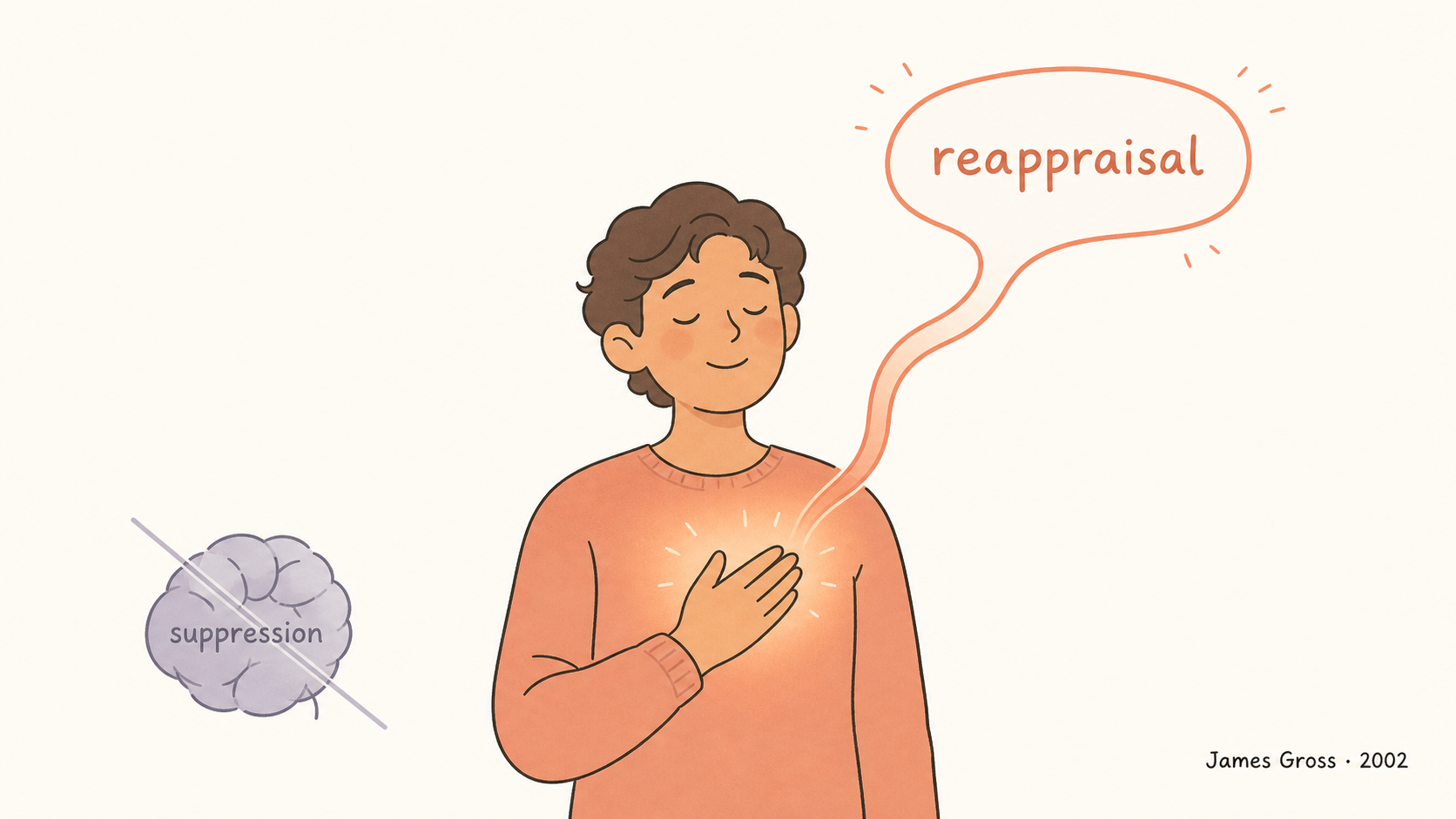
Waking up is not a lightning-bolt event. People with the observer online still laugh, cry, get angry, and make mistakes; the difference is entirely internal. James Gross’s 2002 emotion-regulation research found that reappraisal — changing how you interpret an experience — beats suppression. Awake people are not numb. They feel fully; they are just no longer fooled by the performance.
7. Letting go was never about deleting the memory — just turn off auto-save
You cannot wipe the cache; you can only change what gets permanently written to it. Matthew Lieberman’s 2007 fMRI study found that simply labeling an emotion out loud measurably reduces amygdala activity. Baljinder Sahdra’s Nonattachment Scale research shows high-nonattachment people are not suppressing anything — they feel everything, they just do not file every feeling as part of their identity. The move: say the feeling out loud in one sentence before doing anything else.
8. That trait you are sure is “just who you are” may be code a five-year-old wrote
Your prefrontal cortex — impulse control and emotional regulation — does not fully mature until your mid-twenties. Caballero and colleagues published this in Neuroscience and Biobehavioral Reviews in 2016; Vijayakumar’s team confirmed it in 2014. So your emotional defaults were written on hardware that had not shipped its most important chip yet. Ask a reflex one question: how old is this response? The answer is almost certainly younger than you think.
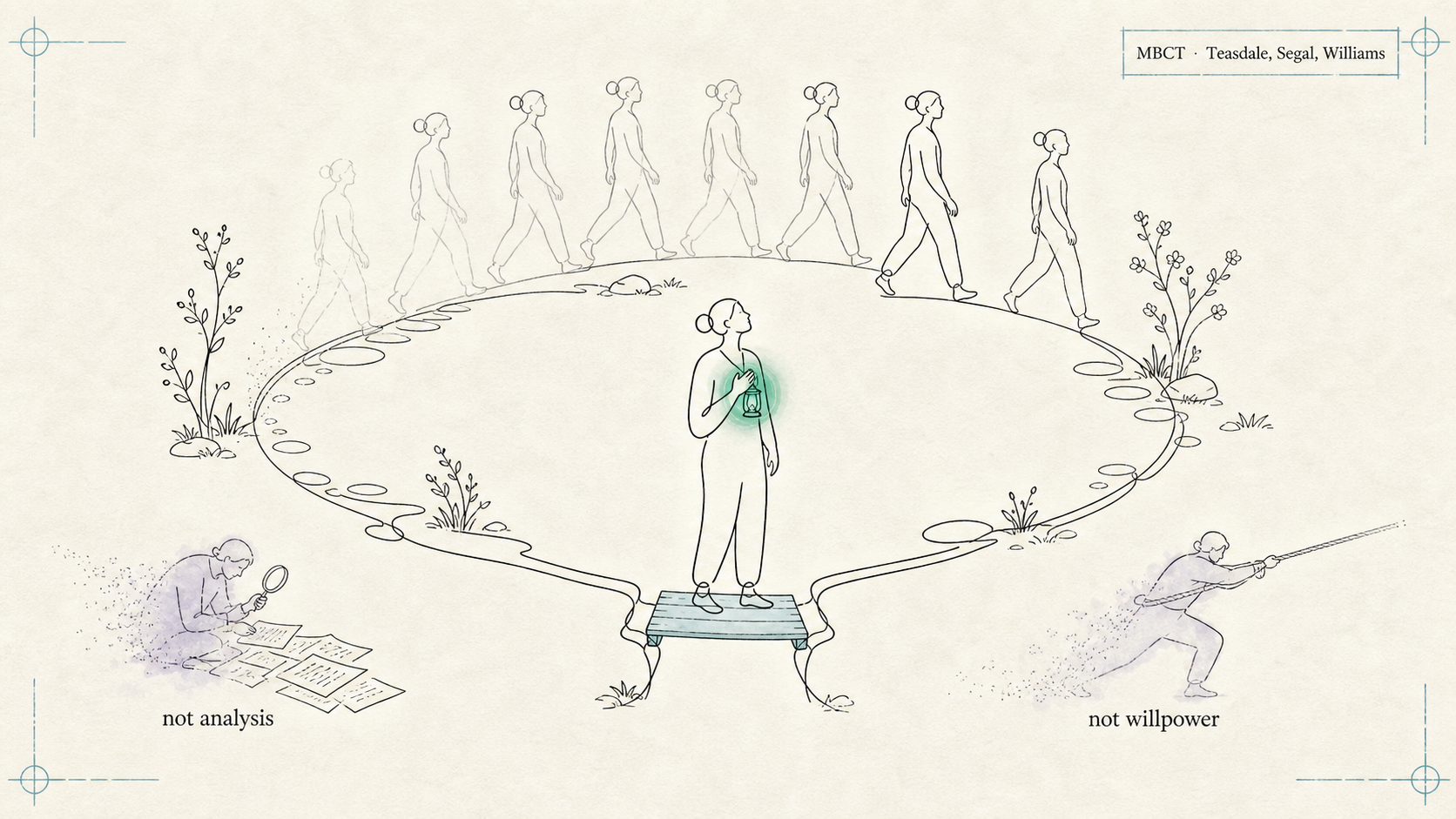
9. Watching a bad pattern, without trying to fix it, is enough to start rewriting it
This runs against every instinct — the moment we catch ourselves on autopilot, we grab the wheel and yank. But the first move is not force; it is observation. Mindfulness-based cognitive therapy, developed by Teasdale, Segal, and Williams, cuts depression-relapse rates not by teaching people to think differently but by teaching them to notice their thinking. The observation interrupts the loop. Not the analysis. Not the willpower. The noticing.
10. Your life keeps snapping back to the same emotional temperature
The raise that vanishes back into the same baseline; the panic that resolves to the same set-point. Psychologists call it the hedonic treadmill — Brickman and Campbell, 1971. But the update most people miss: Diener and Lucas showed in a landmark 2006 American Psychologist paper that set-points are real but not fixed, and Lyubomirsky’s team found that windfalls fade fast while intentional, deliberate activity moves the dial and keeps it moved. The set-point is just the last value nobody bothered to recalibrate.

11. Once you can steer the engine, the only question left is where you have been pointing it
An objective function does not care what it optimizes for — and neither will you, if nobody audits it. Sheldon and Elliot’s self-concordance research (in the Journal of Personality and Social Psychology) found that achieving externally imposed goals gives little to no well-being boost — reward hacking, the human version. Deci and Ryan’s Self-Determination Theory names the three conditions a genuinely aligned goal must satisfy: autonomy, competence, and relatedness. Miss any one, and you will achieve the goal and feel nothing.
Read the manual
Eleven truths, eleven chapters, every one backed by a named study — and every one paired with a hands-on protocol you can run on a commute, in a meeting, or lying awake at two in the morning. The realization behind the book is simple: the architecture of the mind and the architecture of the systems we build to mimic it are structurally the same.
The Modeling Mind is a 165-page field guide blending cognitive science, AI, systems thinking, and contemplative practice into one question: what changes when you finally see the engine that has been running you? Get the book on Gumroad ($29), or browse more editions at ebook.wiki4what.com (Simplified Chinese $19 · Traditional Chinese $19). By Leo Wang · leowang.net.
You have been running this machine your whole life without a manual. Now you know the manual exists. What would you do differently if you could actually read it?
Watch more first-principles field guides on Wiki4What, or read the essays at blog.wiki4what.com.