
The Shape Is the Information: How Structure Changes What Systems Can Do
The parts alone do not explain a system: their relationships determine what it can do, where it can fail, and how its difficulty can change.

Chinese version: 中文版
Imagine a building where every brick, beam, door, and window is still present, but someone has rearranged them at random. Nothing is missing. Yet the staircase leads into a wall, the doors open onto empty air, and the roof has lost the columns that held it up. You still have all the parts. You no longer have a building.
That difference is the subject of Structured: the hidden architecture beneath the world, the mind, and the machines we are learning to direct. We often assume that if we know enough about the pieces, we understand the whole. A building teaches a harsher lesson. To understand it, we also need the plan: positions, connections, dependencies, and boundaries.
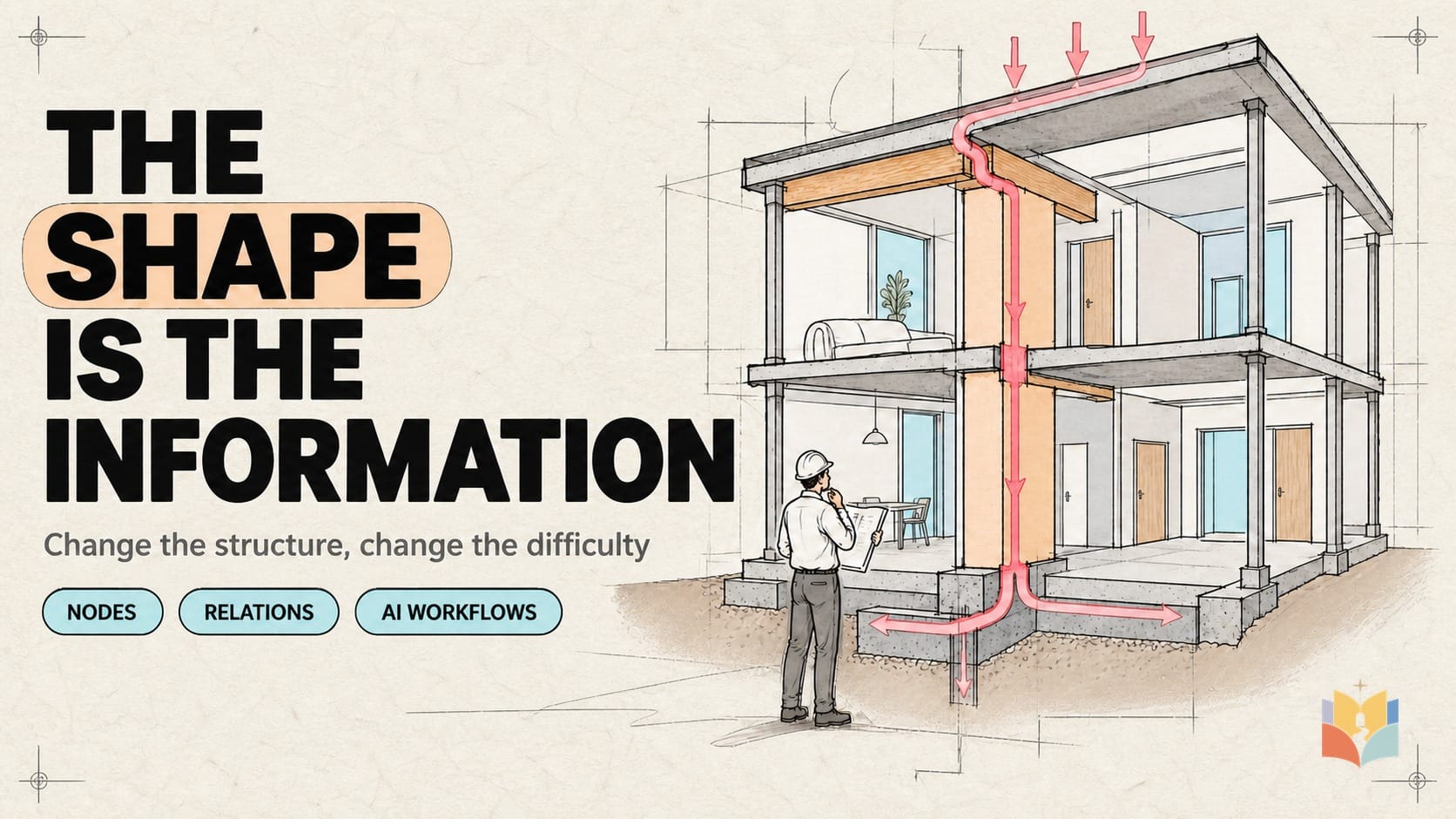
The shape is the information.
Parts are not enough
A useful working definition is that a structure is a set of nodes plus the shape of the relations among them. The nodes are the parts. The relations tell us what connects, what depends, what carries weight, what can move, and what must remain separate.
Changing those relations can change what the parts are able to do. Graphite and diamond are made from the same element, carbon, but different atomic arrangements help give them radically different properties. Some butterfly wings build color from microscopic architecture rather than pigment alone. The ingredient list matters, but arrangement completes the explanation.
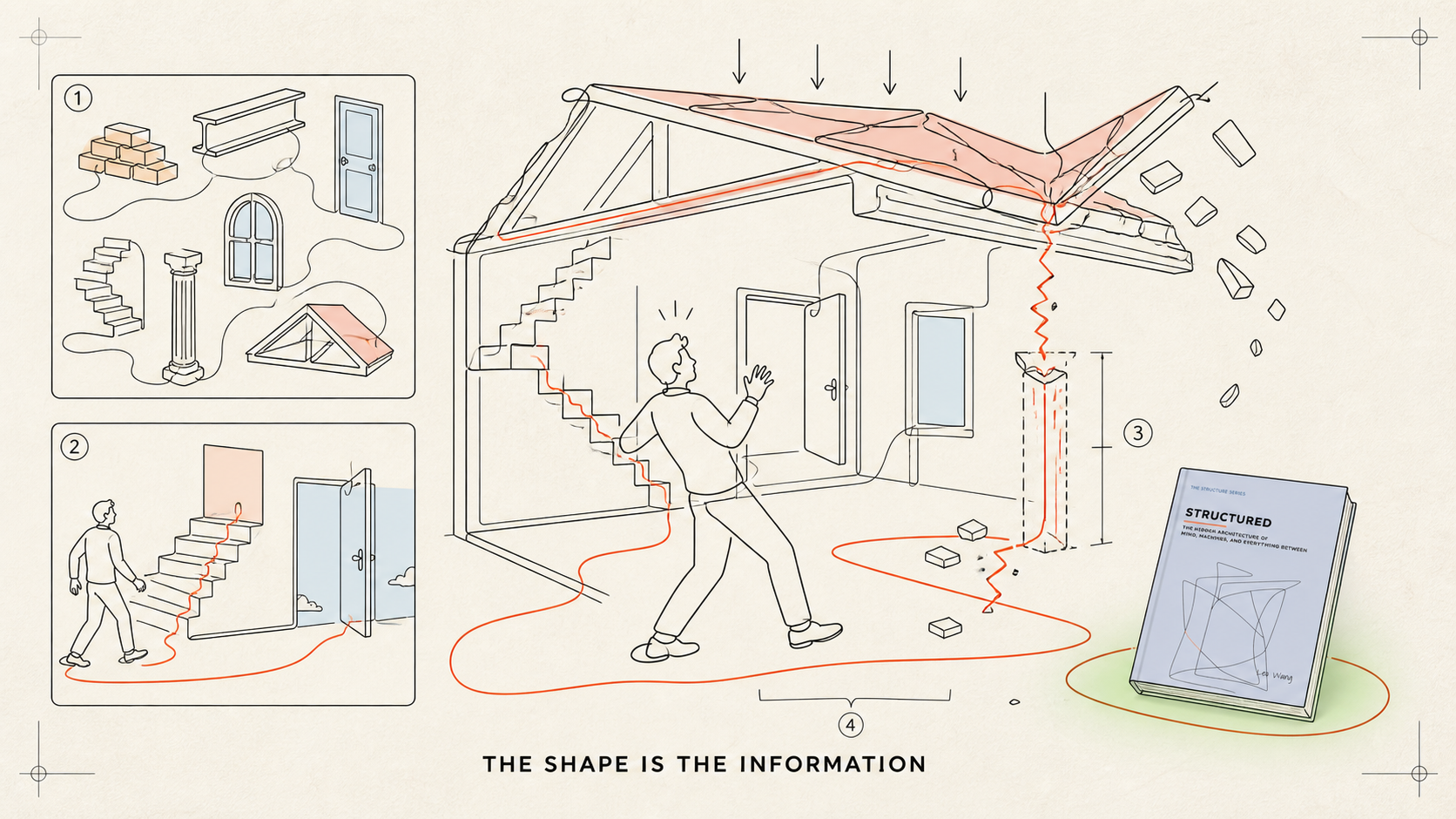
The same principle appears in music. Transpose a familiar melody and its absolute pitches can all change, yet the song survives because the pattern of intervals remains recognizable. Preserve the relations and identity can travel into new material. Preserve the notes but scramble their order, and the melody disappears.
Find the load-bearing walls
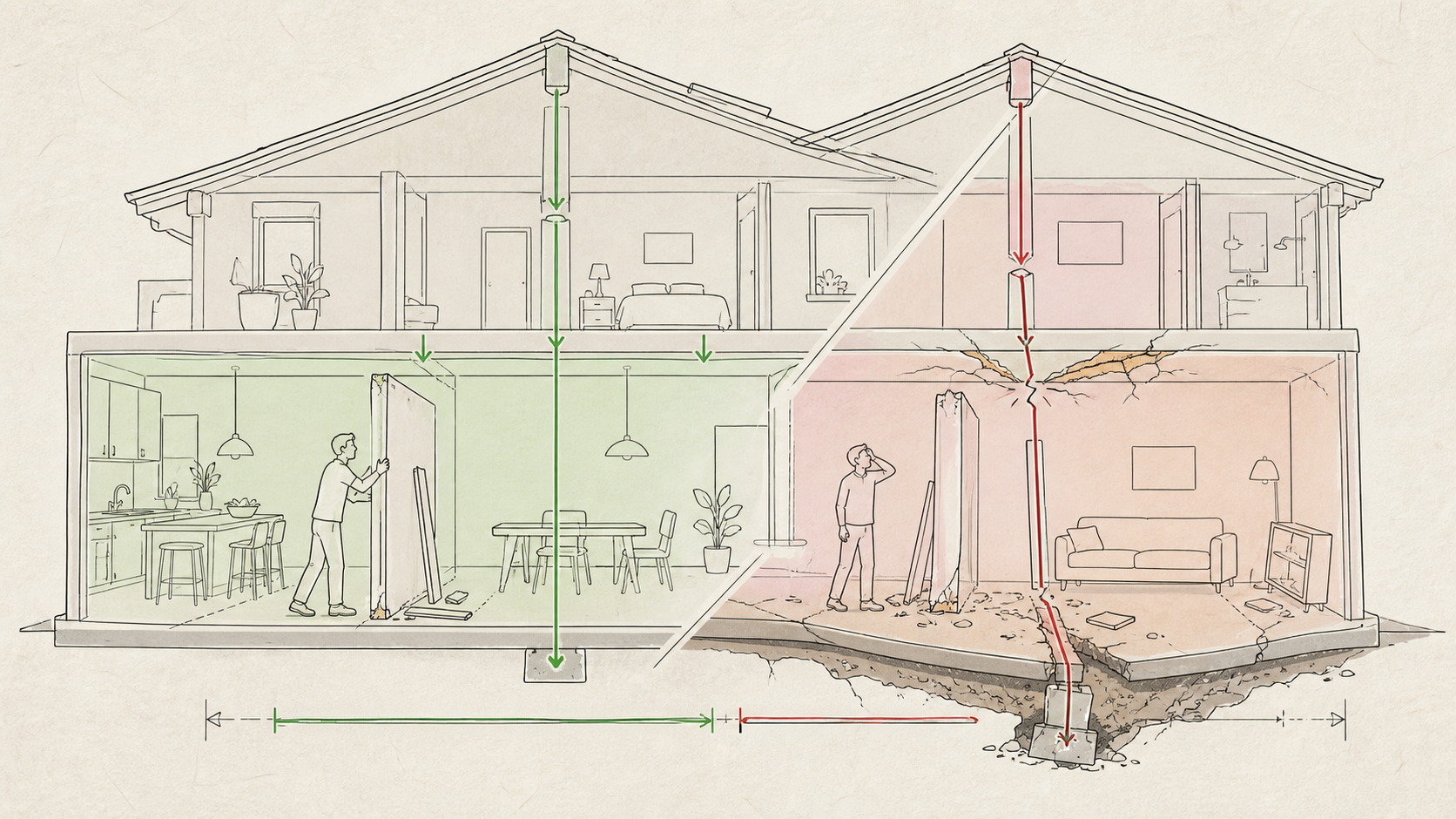
A load-bearing wall and a partition may wear the same paint. One holds up the floor above; the other merely divides two rooms. Their visible material can look identical. Their position inside a network of forces makes one critical.
This question travels well. Which task controls a project's finish date? Which person is the only bridge between two teams? Which assumption supports every conclusion in an argument? Which software service does everything else call? These are structural questions about importance created by position.
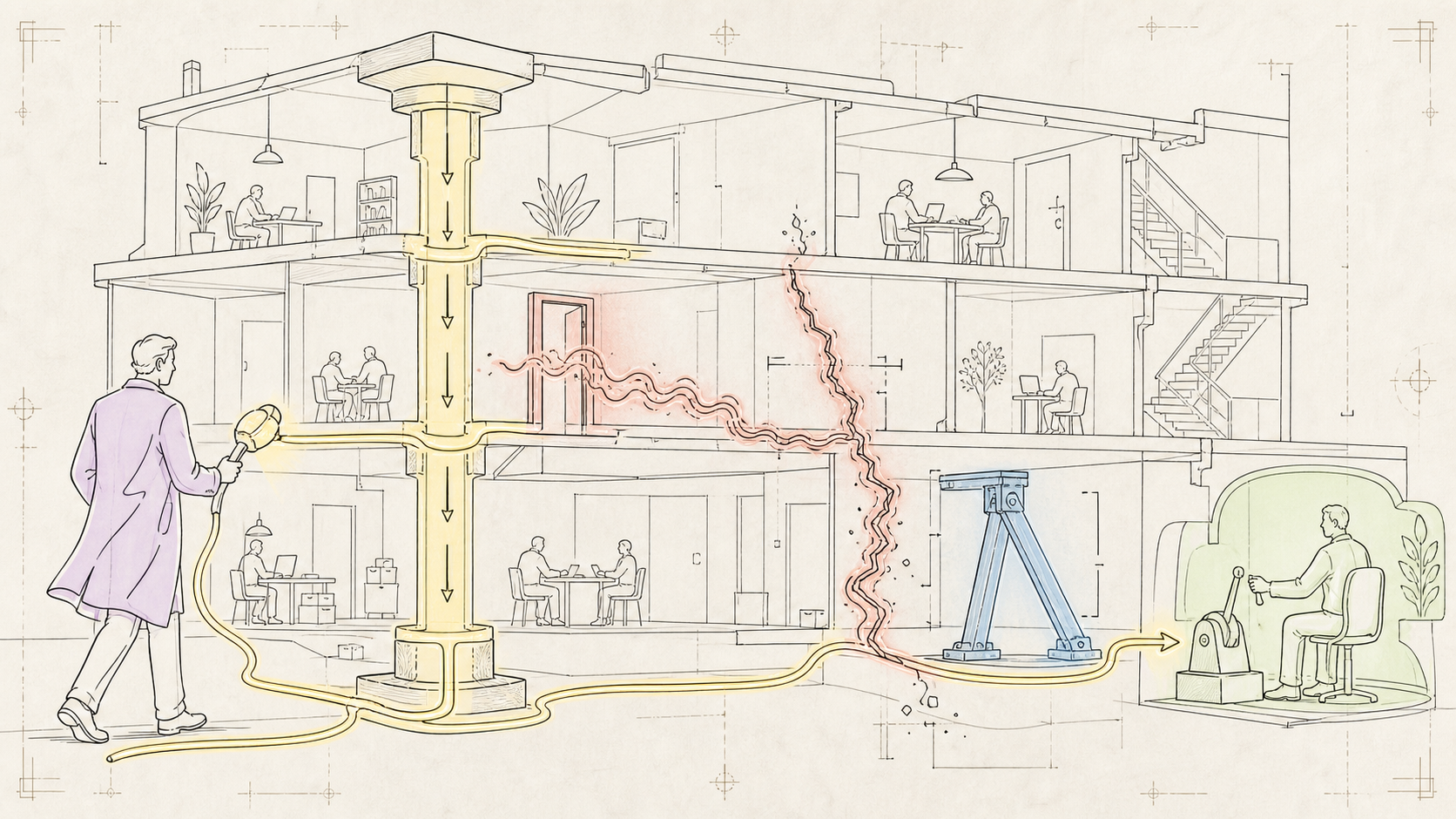
A practical test is to mentally remove a node and watch what happens. If the system reroutes and recovers, the node may be replaceable. If everything downstream stops, you have found something load-bearing. Reliability then means adding a fallback or reducing the consequence of that single failure.
When the blueprint turns inward
Most learning resembles carrying a new chair into a finished room. You add a fact, quote, or technique, but the floor plan stays intact. You can retrieve the information without changing how you first interpret a situation.
Cognition is closer to renovation. A new experience refuses to fit the old room, so a doorway moves, two rooms merge, or a wall comes down. Jean Piaget described two related moves: assimilation fits something new into a schema we already have, while accommodation changes the schema because the new experience will not fit honestly.
A strong mental structure makes us fast because it gives every new thing a likely room. But speed can become blindness. We may classify a genuinely new problem before we have really looked at it. The wall that once organized the world can become the wall blocking our view.
AI is a learned configuration
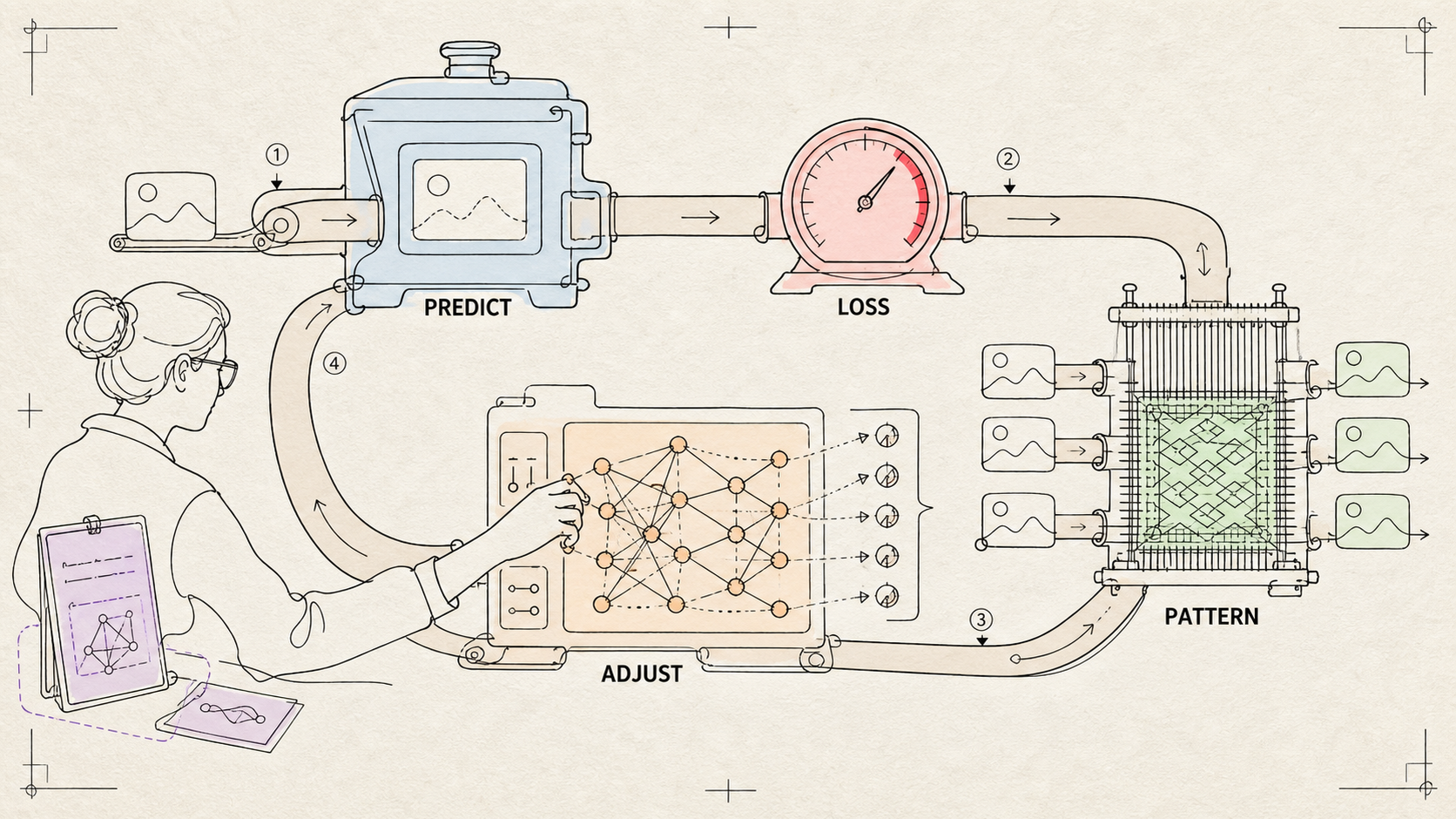
The common picture of an AI model is a warehouse of facts, with one answer stored in each box. A better picture is a vast control room filled with adjustable valves. Each parameter slightly amplifies, suppresses, or redirects signals, and no single setting explains the model's ability. Behavior emerges from a configuration across a large network.
Training adjusts that configuration through error. A model predicts, measures the miss, and changes many parameters in directions that reduce similar misses later. This resembles compression because finite settings represent patterns across many examples. But compression and memorization can coexist: language models can sometimes reproduce specific training passages. General competence is distributed, not filed in a neat cabinet.
The brain and an AI model are not the same machine. A synapse is living biology; a parameter is a number. The analogy is structural rather than literal. Both remind us that a connection can matter more as part of a pattern than as an isolated object.
Interfaces are doorways
Structure is not only something we discover. It is something we design. A story is not a bag of events; order can turn the same events into a mystery or a tragedy. A program is not a pile of instructions; it is a goal decomposed into modules and interfaces, then reassembled. A workflow is not a list of capable tools; it is the contract governing what each tool receives, returns, and does when something fails.
In a building, an interface is a doorway. It hides the internal complexity of one room while specifying how another room may connect. Structured data plays the same role in software. A schema says which fields exist, which kinds of values belong in them, and what counts as invalid. Systems built in very different ways can cooperate if the shape crossing their boundary remains stable.
Change the representation, change the difficulty
A tidy list can still represent a problem badly. Sometimes difficulty belongs not only to the problem, but to the form in which we are holding it. The Smith chart gave radio engineers a vivid example: Phillip Smith mapped impedance relationships onto a disk so operations that had required complex algebra could be read as movement along arcs. The physics did not change. The representation did.
Change the structure and you change the difficulty.
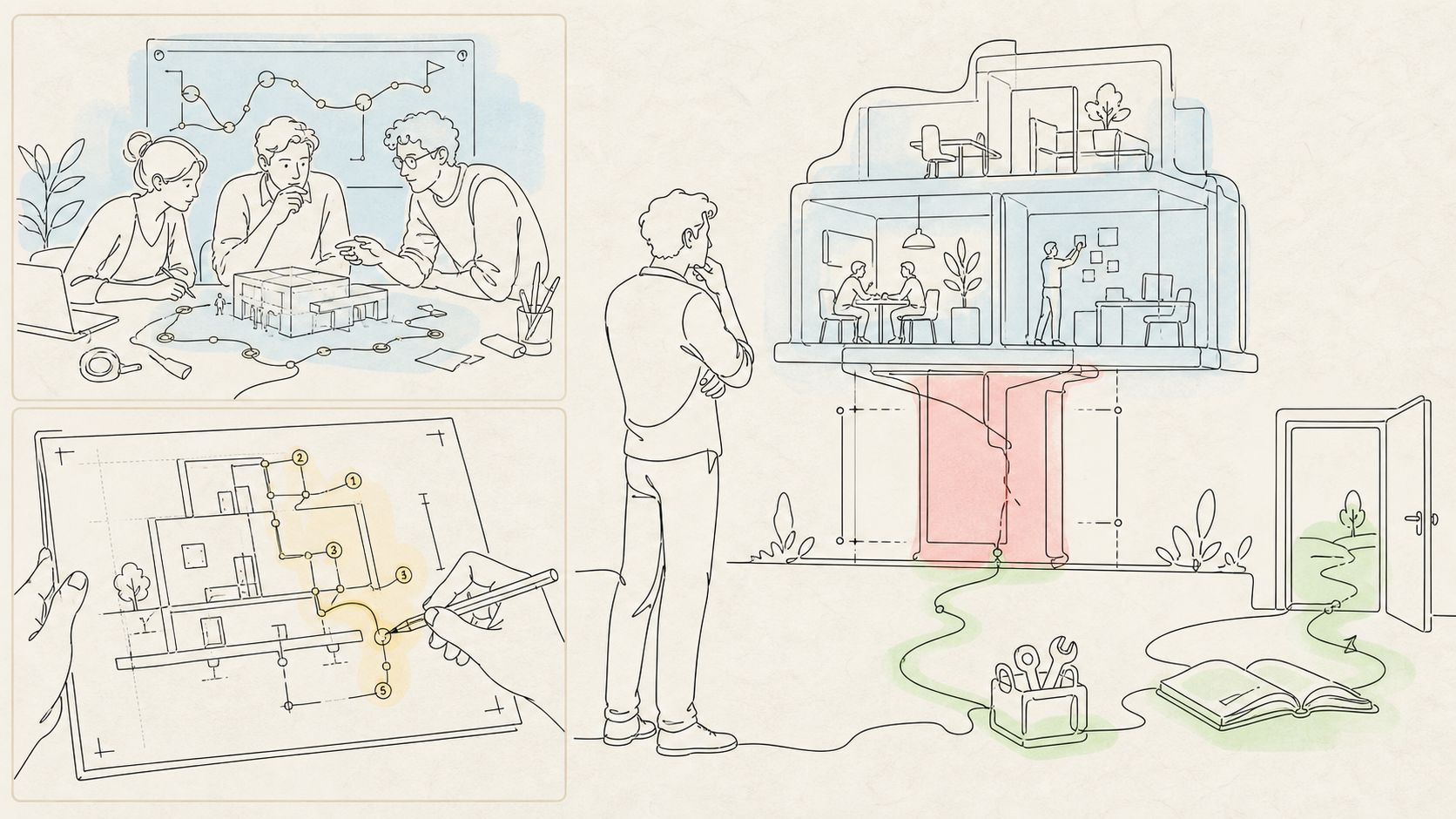
A tangled project becomes more manageable when we draw its dependencies. A vague ambition becomes actionable when we split it into small operations. A disagreement changes when we stop arranging it as two opposing positions and map the interests underneath. Re-representation does not guarantee an easy answer. It gives the answer a better chance to become visible.
The AI-age payoff
Working with AI can be seen as movement through three arrangements. In chat, the machine advises while a person carries each answer into the world. An agent can use tools, observe results, and correct its next step. A workflow connects agents, skills, commands, data, and quality checks into a repeatable process.
The person directing that workflow is not merely issuing prompts. They are reading a building. Which node is load-bearing? Which interface is leaking meaning? Where can an error cascade? What needs a fallback? Where must a human retain judgment?
Consider an automated publishing line. One node chooses a topic, another drafts, another checks facts, and another makes the cover. Near the end sits a quality gate allowed to reject the entire run. It may produce nothing visible, yet it is load-bearing. Remove it and the system appears faster while gaining the ability to publish polished nonsense at scale.
As generation becomes cheaper, judgment becomes more valuable. The scarce work moves toward the two ends: defining what should exist and deciding whether the result deserves to leave the building. The middle can be increasingly automated. Purpose and accountability cannot simply be wished away.
Six moves for structured thinking
- Decompose a large problem until its pieces can be handled.
- Find the load-bearing walls instead of distributing attention evenly.
- Read the interfaces, because failures often live in handoffs.
- Look for possible isomorphisms, then test which constraints and meanings survive before borrowing a solution.
- Re-represent the problem when effort is rising but clarity is not.
- When no map exists, traverse first: take a small step, observe what it reveals, and let a useful map emerge.
Suppose you want to learn an unfamiliar field with AI. The unstructured approach is to ask broad questions, save dozens of answers, and mistake a growing archive for progress. A structural approach maps the field into connected territories, identifies the concepts everything else depends on, gives each research task a clear input and output, and checks the handoffs for missing assumptions. When an explanation stays confusing, it redraws the concept as a timeline, causal map, or comparison.
Where the building analogy stops
Buildings usually have deliberate architects, crisp blueprints, and parts with fairly clear boundaries. Natural systems can self-organize. Minds rewrite themselves while they are in use. Organizations contain people who react to a map once they see it. AI workflows change with their tools and environments. In these systems, nodes may be fuzzy, relations may be hidden, and the blueprint may be an evolving hypothesis rather than a final plan.
The analogy still leaves us with a durable habit. When something feels confusing, do not ask only what it is made of. Ask what connects to what, where the load travels, which boundary is failing, and whether the problem has been drawn in the wrong shape.
For the complete framework, cross-domain examples, and practical methods, you can read or purchase Structured. The book goes deeper, but you can begin now by drawing the blueprint of one project, team, learning plan, or AI workflow you already own.
If you drew that blueprint today, which wall would surprise you by turning out to be load-bearing?
Watch more first-principles field guides on Wiki4What, or read the essays at blog.wiki4what.com.