
A Historical Map for Choosing a Buddhist Path
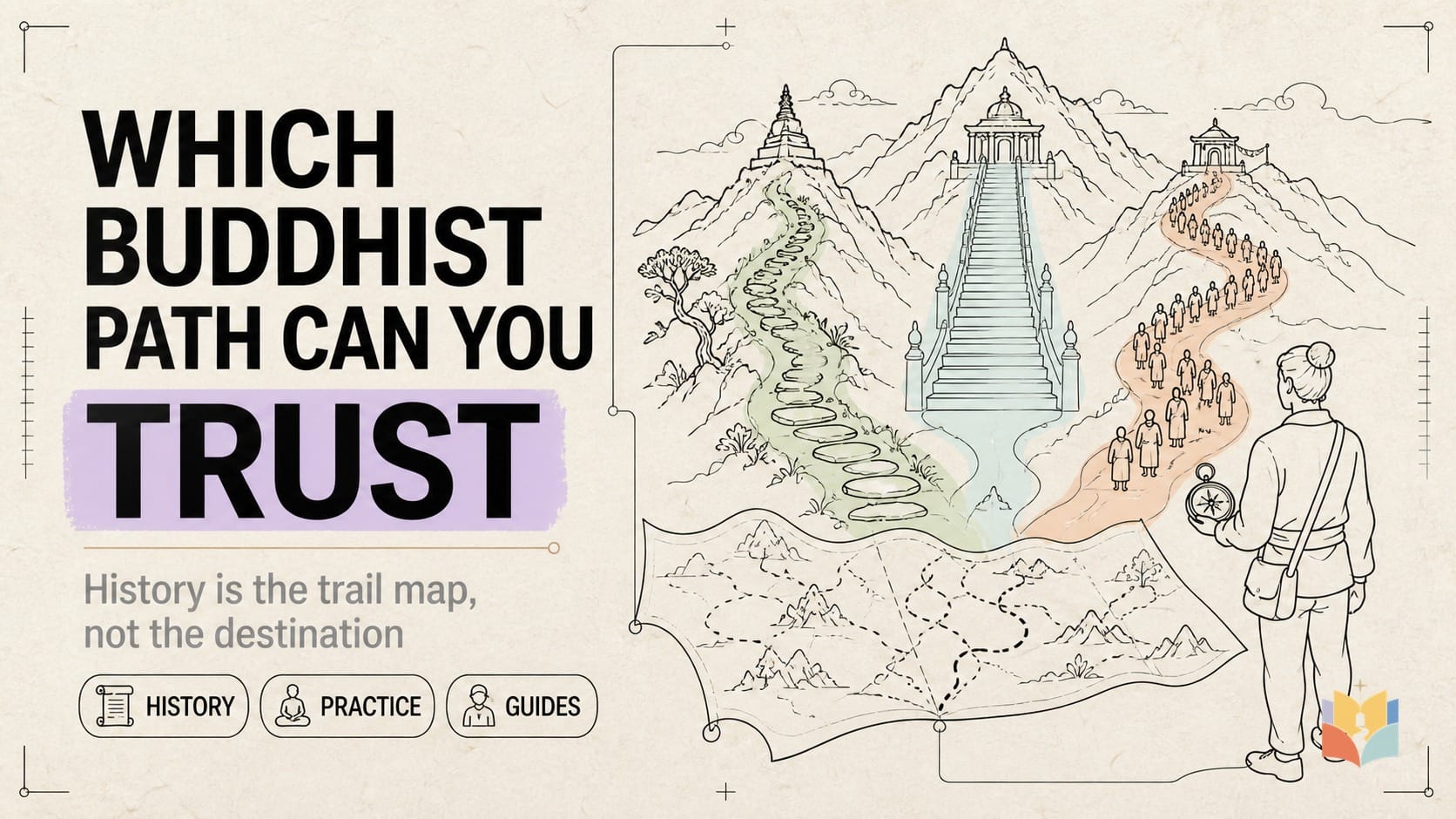
Buddhist history is a trail map, not a ranking: use its routes, compass, and guides to judge practices without surrendering your judgment.

Chinese version: 中文版
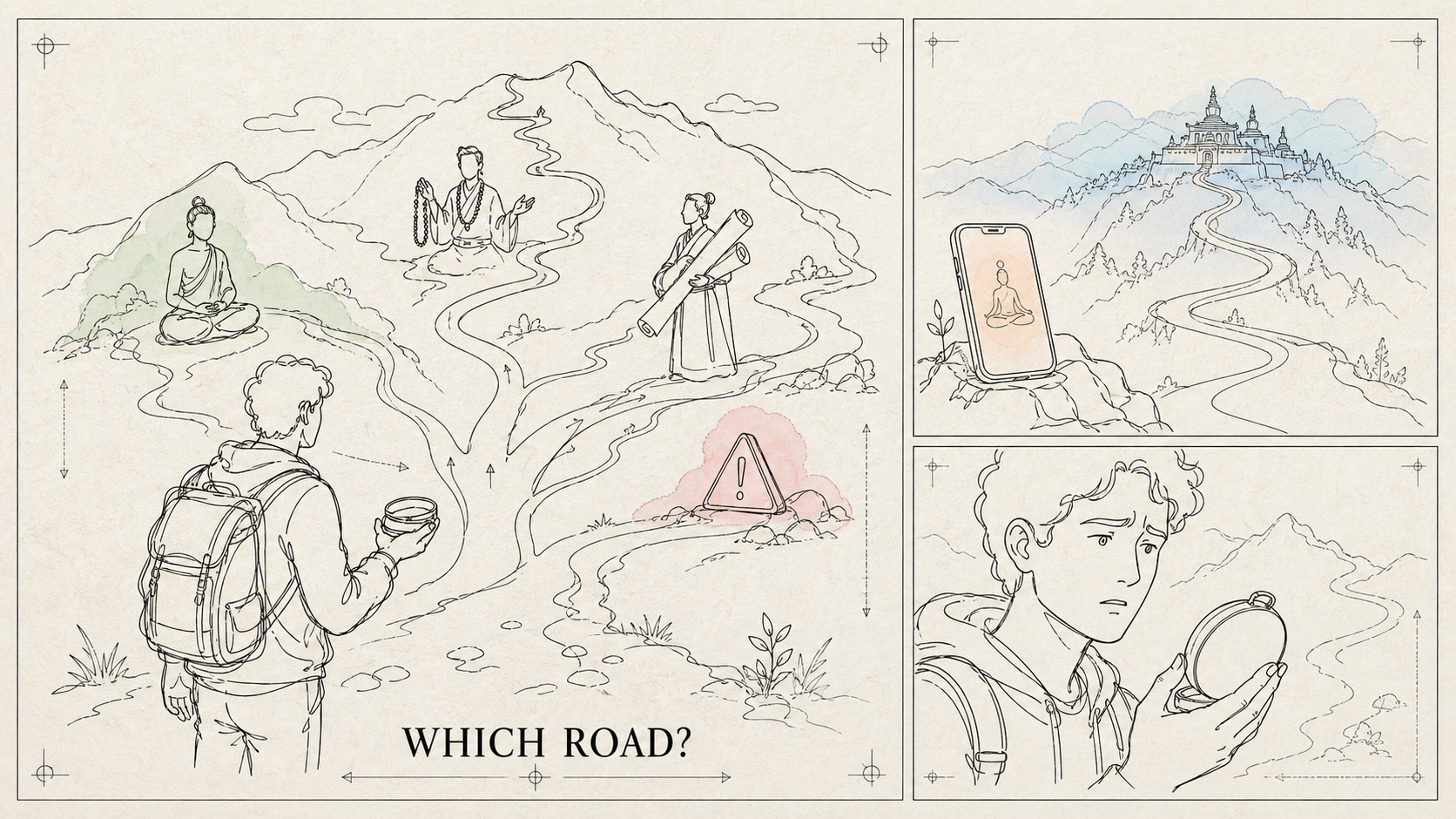
Buddhism can look like a hundred roads sharing one name. One teacher asks you to sit in silence; another gives you a mantra. One community prizes philosophical study; another emphasizes devotion, ritual, or direct experience. Modern mindfulness may promise calm in ten minutes, while a monastery asks for years of discipline. The variety is real. So is the problem it creates: how do you choose without becoming cynical or gullible?
A useful answer begins with a different question. Instead of asking which school is simply highest, oldest, or most popular, ask what problem each route was built to solve, what it preserved, and what it may make harder to notice. Buddhist history then becomes a trail map, not a ranking table.
History cannot choose a path for you. It can make manipulation more expensive.
The compass: distress, conditions, and practice
The earliest layers of Buddhist teaching begin with dukkha. The word is often translated as suffering, but it can also include stress and the unsatisfactoriness or unreliability of conditioned experience. The diagnosis is not that one villain causes every form of pain. It is that distress arises through conditions, with craving and clinging playing central roles, and can change when those conditions change. The path therefore joins understanding, ethical conduct, and mental cultivation rather than treating meditation as an isolated trick.
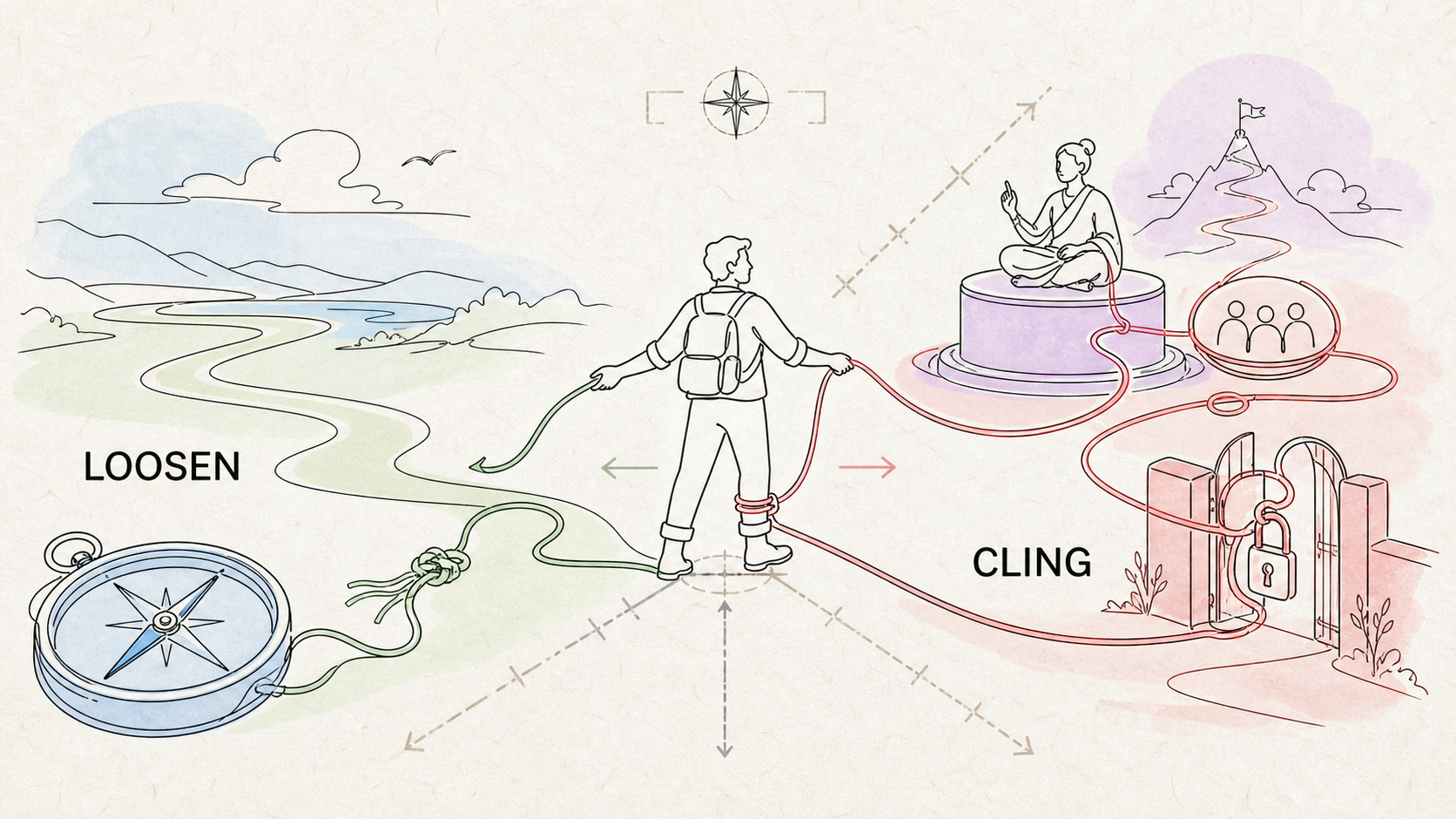
That gives us a practical compass. Does a teaching help people see how distress is being produced and loosen the clinging that sustains it? Does it make ethical conduct more concrete? Or does it create a new object of clinging: a teacher, an identity, a promised state, or the belief that one group alone owns the summit? The early discourse on the Four Noble Truths is one useful primary-text starting point for this diagnostic.
A good friend is not a substitute for judgment
The Chinese term shan zhishi, or 善知识, expresses a Buddhist idea often rendered as a good friend, admirable friend, or spiritual friend. Related Sanskrit and Pali terms—kalyāṇa-mitra and kalyāṇa-mitta—point to the same basic image: a good companion on the path. This may be a teacher, mentor, or fellow traveler who helps someone move toward awakening.
In SN 45.2, Ananda suggests that good friendship is half of the spiritual life. The Buddha replies that it is the whole of the spiritual life, connecting good friendship to cultivating the Noble Eightfold Path. This is not a command to surrender judgment to charisma. The mind examining itself has also been shaped by habits, fears, and blind spots. A trustworthy guide does not replace your seeing; a trustworthy guide helps you see what you were missing.
Why the map began to branch
After the Buddha's death, an existing challenge became more urgent: teachings and discipline had to be remembered, recited, organized, and transmitted without the founder present. The sangha—here, especially the monastic communities that preserved and practiced the teachings—became part shelter and part navigation system. Vinaya, the body of monastic discipline, also served as a protocol for keeping communities together through ordinary human friction.
This is the map's first lesson. A tradition is never only a set of ideas. It is also a memory system, a community, and an institution. Each can protect a teaching. Each can also distort it.
As early Buddhist communities spread and debated, Abhidharma traditions developed precise systems for analyzing mental and physical events. Think of them as topographic surveys: they name the rocks, measure the slopes, and analyze what looked like one solid self as changing processes. The precision can clarify experience, but any student can still mistake the survey for the mountain. The Stanford Encyclopedia of Philosophy overview of Abhidharma is a careful introduction to this analytical project and its internal diversity.
Mahayana changed the emphasis, not the need for care
Overlapping with these scholastic developments, diverse movements gradually emerged that were later grouped under the name Mahayana. Their origins were historically complicated, not a clean launch by one founder on one date. A defining emphasis in many Mahayana communities was the bodhisattva path: seeking Buddhahood for the benefit of all beings. This should not be turned into a caricature in which every non-Mahayana practitioner seeks only private escape. It marks a powerful change of emphasis and aspiration, not a license for sectarian ranking.
Mahayana texts also recentered and elaborated language such as shunyata, or emptiness. Emptiness does not mean that nothing exists. It challenges the idea that things possess fixed, independent essences. Madhyamaka thinkers used that insight to show how useful concepts become hardened into supposed absolutes. Yogacara traditions developed sophisticated accounts of perception, consciousness, and the patterns through which experience is constructed; scholars continue to debate how those accounts should be interpreted.
These systems are easier to understand when we ask what practical questions called them forth. How can a teaching about no fixed self avoid becoming another rigid doctrine? How can habits continue without a permanent soul? How does compassion reshape the purpose of practice? For responsible orientation, see the Stanford Encyclopedia entries on Madhyamaka and Yogacara.
Translation, transmission, and portability
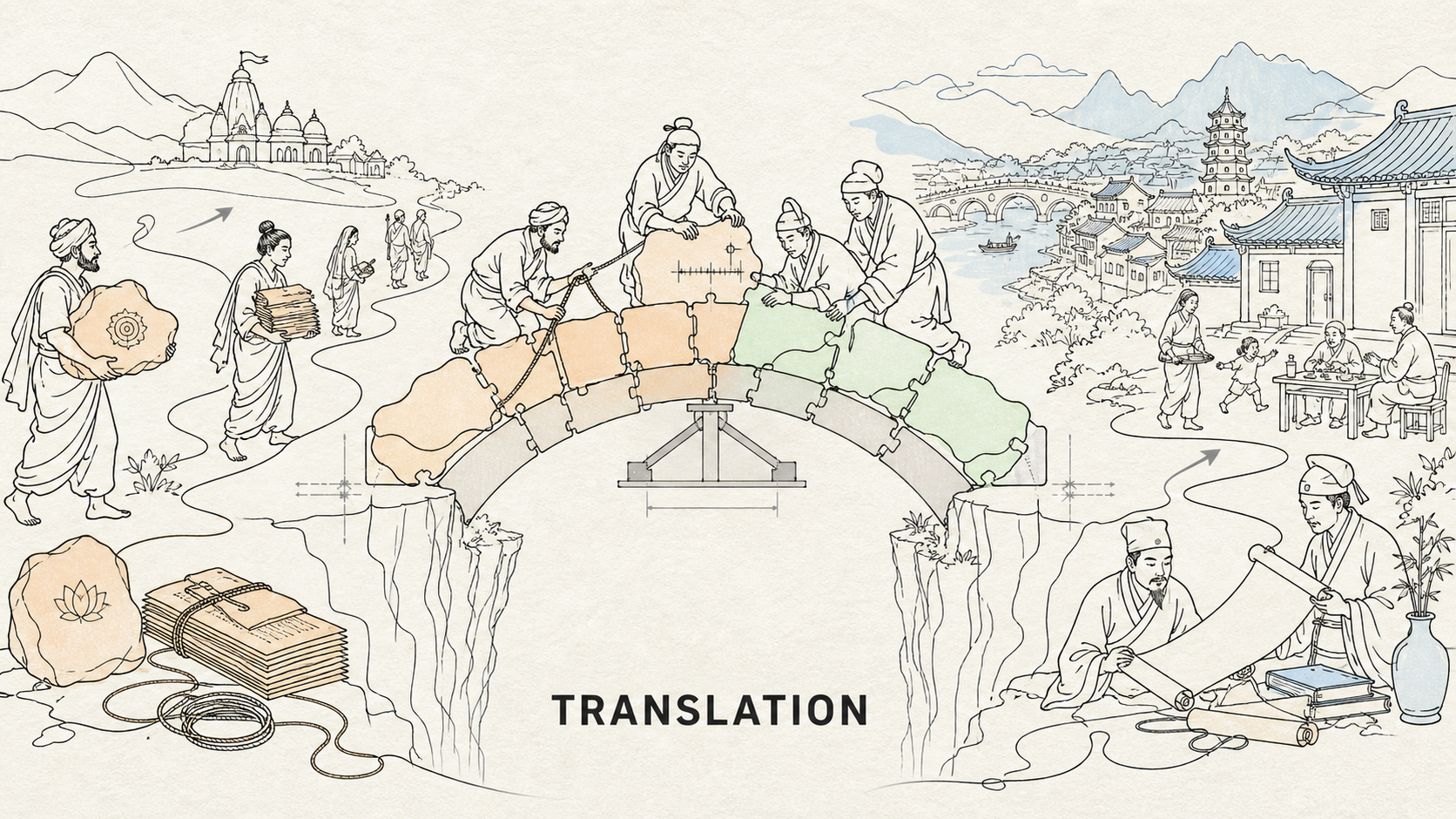
When Buddhism was transmitted into China, translators had to build bridges between Indian concepts and a civilization with its own language, philosophy, family structure, and political history. Over time, Chinese traditions including Tiantai, Huayan, Chan, and Pure Land developed distinctive ways of organizing and practicing the teachings. Chan was transmitted to Japan, where related traditions became known as Zen. Chan emphasized direct, embodied realization, but it was never simply the rejection of texts. Pure Land traditions made devotional practice widely accessible to laypeople as well as monastics.
Buddhism reached Tibet through several contacts from about the seventh century onward, with sustained transmission from India becoming especially formative. Tibetan lineages preserved elaborate systems of study, ritual, meditation, and teacher-to-student transmission. Some later Tibetan teachers developed lamrim, or stages of the path, as a major graded-path genre. Different schools also use distinct frameworks, so lamrim should not be treated as one universal Tibetan syllabus.
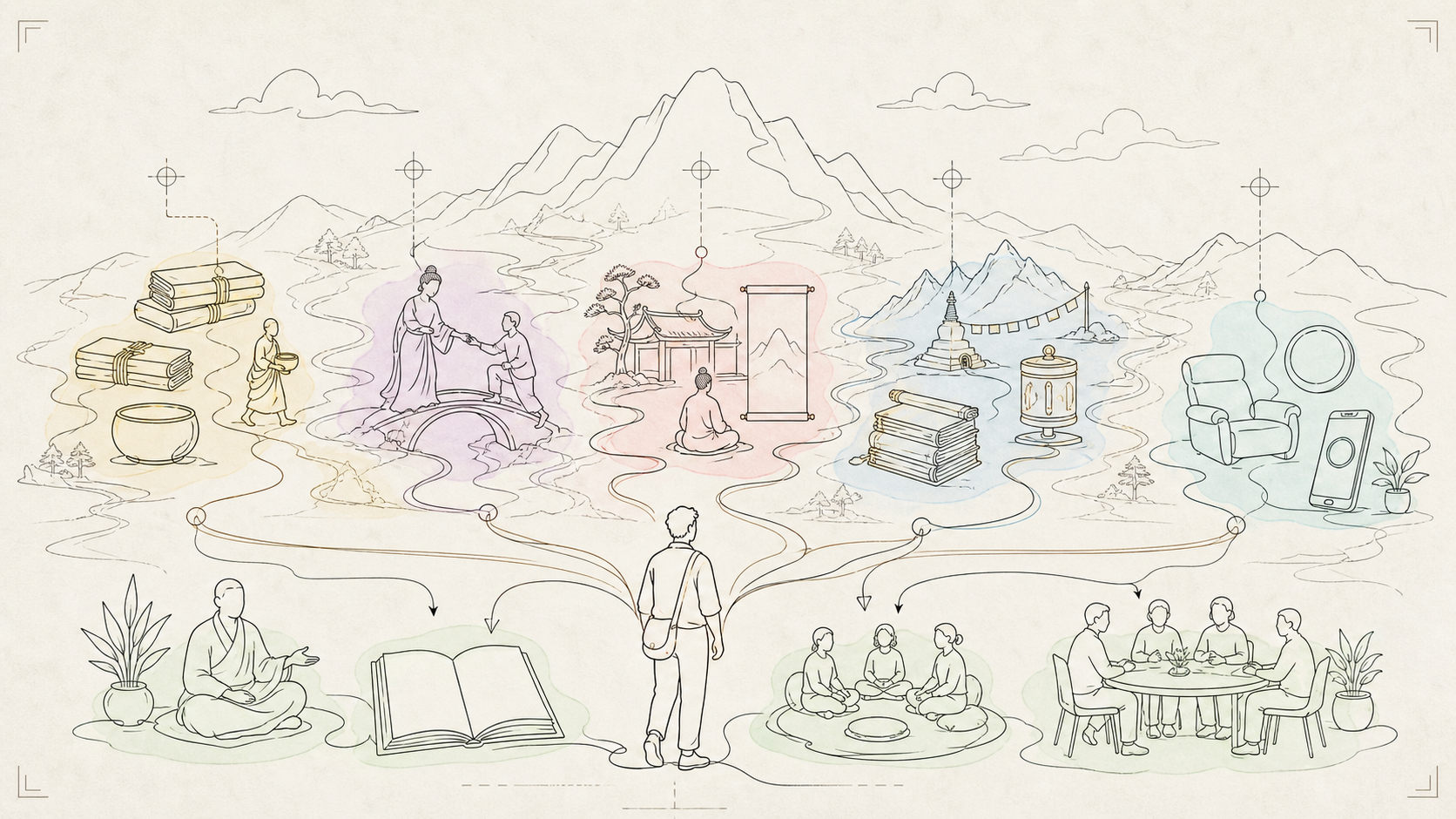
Modern mindfulness is another historical route, not the absence of history. Reformers and teachers carried selected meditation practices beyond monasteries; clinical programs adapted some of them for secular settings; digital products made them nearly frictionless to access. The gain is portability. The tradeoff is that some secular or commercial versions omit or minimize ethics, community, nonself, and liberation. Others retain more context. A method may be useful for calm or stress reduction without having the same destination as the larger Buddhist path from which it was adapted.
These are not rankings. They are coordinates.
Five questions for choosing a guide or practice
Locate the method honestly. Is it drawn from an early discourse, a later commentary, a Chan lineage, a Tibetan manual, a therapeutic program, or a personal synthesis? Innovation is not automatically corruption, and age is not proof. Hiding adaptation while claiming timeless purity is the warning sign. Name the problem it was built to solve. Breath meditation, devotional recitation, ethical precepts, philosophical analysis, and visualization train different capacities and assume different pictures of the path. Ask what difficulty you are facing before asking which method is highest. Watch what the teaching rewards. Does it reduce greed, hostility, confusion, and compulsive self-importance? Does the community permit careful questions? Can senior students admit uncertainty and mistakes? Examine your growing independence. Discipline and challenge are not the same as coercion. If every doubt becomes disloyalty, every outside source becomes dangerous, and every choice requires permission, the relationship is replacing judgment rather than training it. Test the path in ordinary life. Read primary teachings alongside responsible explanation. Meet the community, not only its public face. Notice how people treat those with less status. Look for quieter changes: more honesty, less reactivity, more willingness to stay present with discomfort, and more care for the effects of your actions.
What history cannot certify
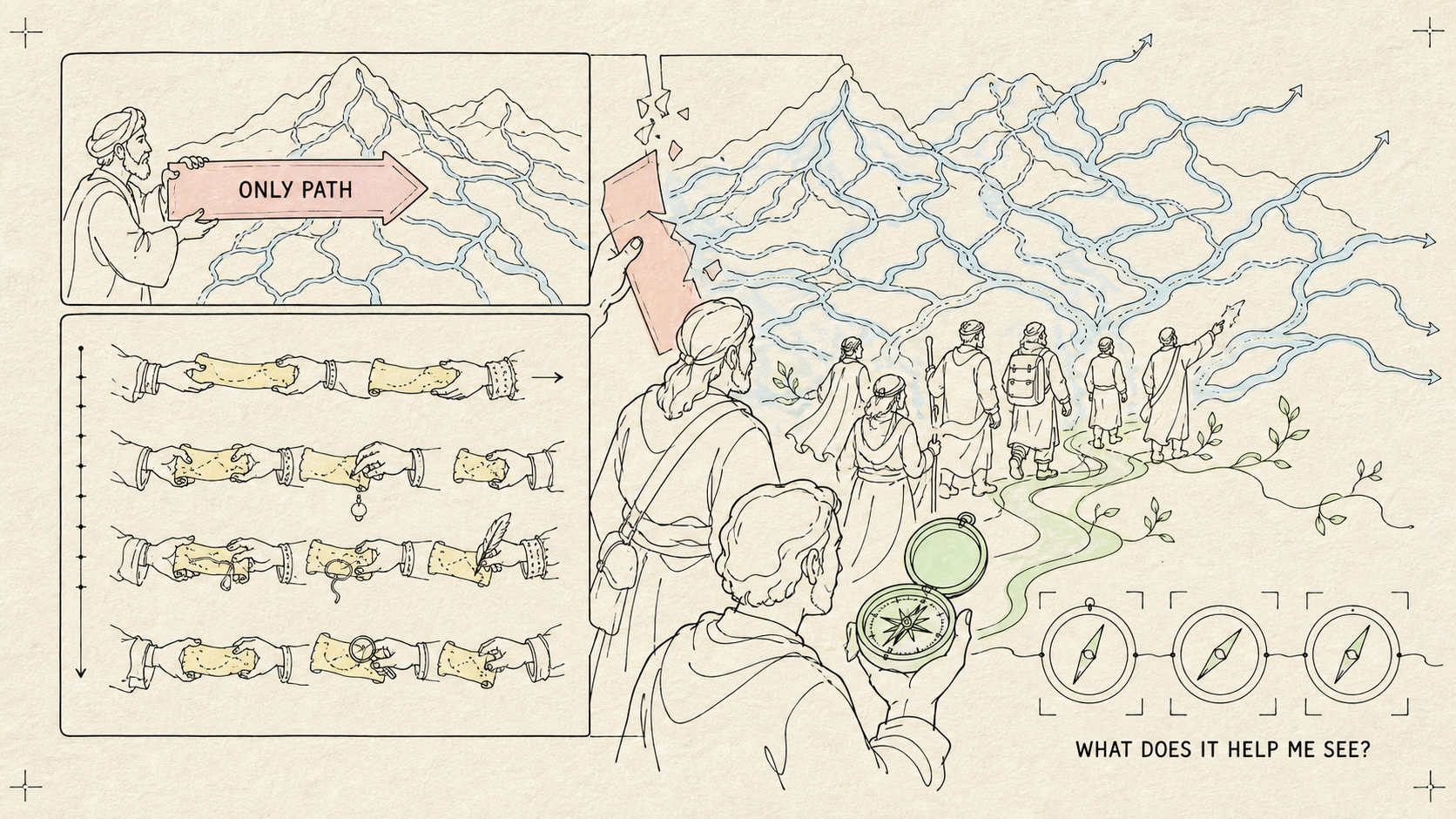
The mountain analogy has a boundary. Religious history is not a satellite photograph. The record is incomplete, dates are disputed, and origin stories are often written by later communities. A documented lineage cannot certify anyone's realization or character. An old institution can harbor abuse; a modern adaptation can be wise and humane. Political patronage, translation, persecution, institutions, and contingency all affect which traditions survive. Survival by itself does not establish truth.
History cannot make the decision for you. What it can do is reveal that every route has a history, every adaptation gains something and risks losing something, and every guide occupies a particular location on the map. The mature question is not, “Which tradition is perfectly pure?” It is, “What is this tradition helping me see, what does it ask me to practice, and what might its own history make difficult for it to notice?”
Continue with the full map
This episode and companion essay draw on Leo Wang's book Shan Zhishi. For the fuller historical map, the teacher-and-authority problem, and a practical framework for choosing a trustworthy spiritual friend, you can read more or purchase the book at ebook.wiki4what.com. The book is a deeper route, not a prerequisite for asking better questions today.
At the crowded mountain entrance, which guide would earn your next careful step: the oldest, the simplest, the most systematic, or the one most willing to show you both the map and its missing pieces?
Watch more first-principles field guides on Wiki4What, or read the essays at blog.wiki4what.com.