
How a Temporary Line Became Korea's Load-Bearing Seam
A hurried surrender line became a structural seam. Learn why the 38th parallel, MDL, DMZ, and armistice are not the same thing.

Chinese version: 中文版
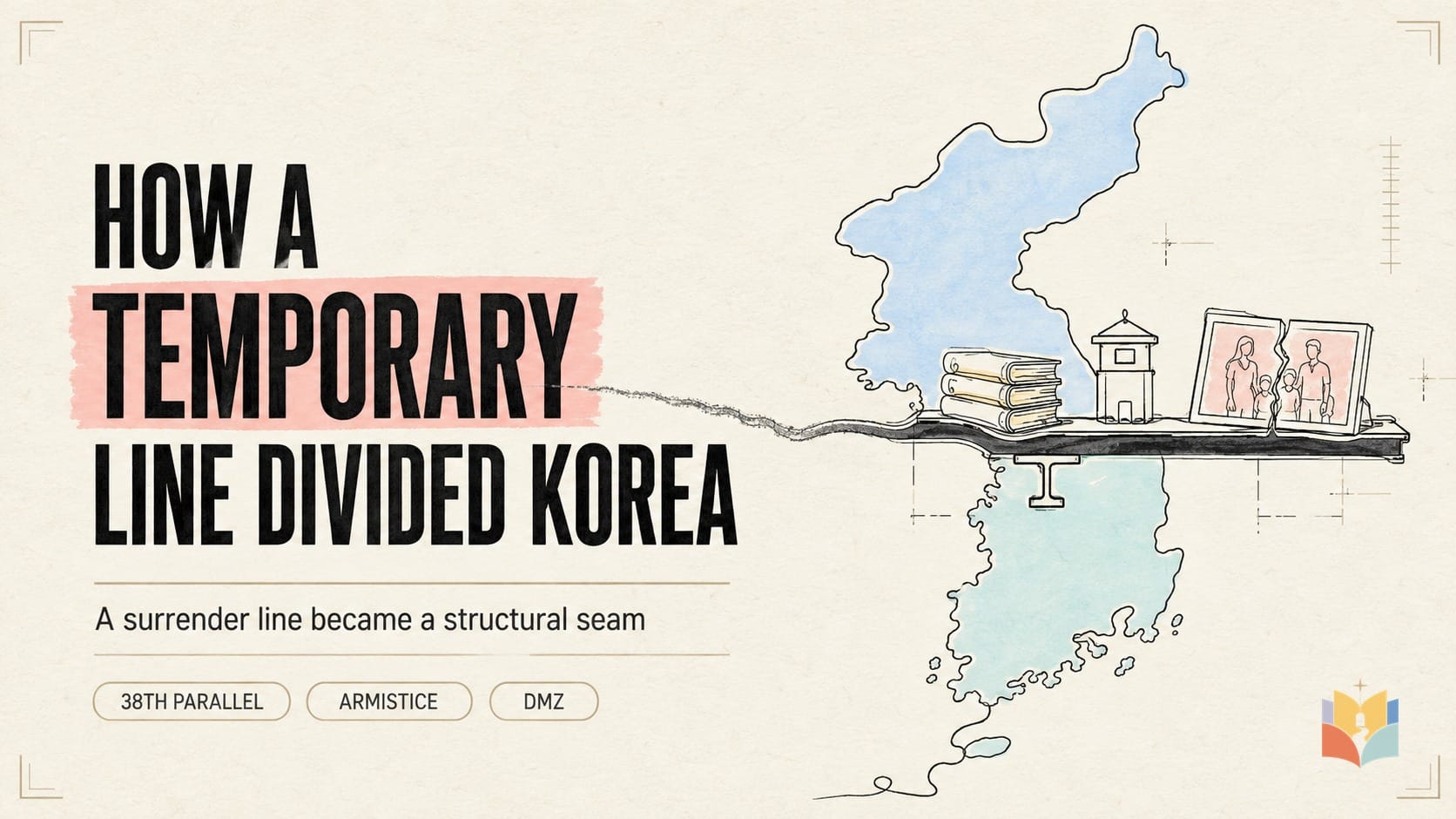
The line across Korea was drawn to solve a surrender problem. It was not a peace settlement, an ancient frontier, or a verdict about what Korea should become. Yet more than eighty years later, that hurried decision still organizes armies, laws, family histories, and much of the world's picture of the peninsula.
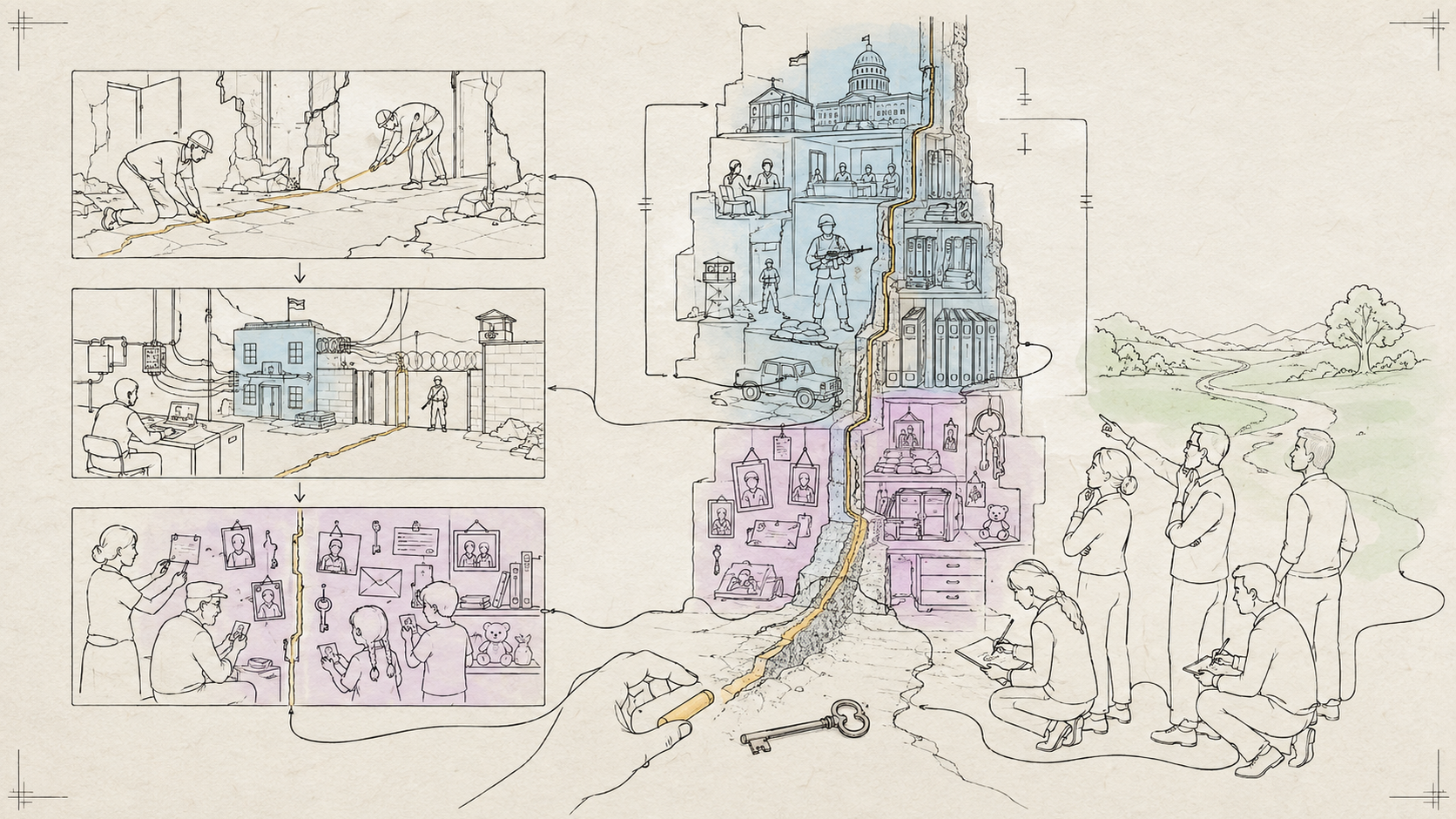
The most useful mental model is not a border carved into stone. Imagine a construction crew arriving after an earthquake. They mark a temporary seam across a damaged building so two teams know where to work. Then each team installs different wiring, reinforces different walls, and issues different keys. The chalk mark does not control the future, but every system built around it makes the seam harder to remove.
A temporary line became load-bearing because later choices began to depend on it.
The emergency mark
On the night of August 10-11, 1945, United States Army colonels Dean Rusk and Charles Bonesteel were asked to propose a line for accepting the surrender of Japanese forces in Korea. American planners wanted Seoul in the American zone, while Soviet forces were already approaching from the north. The two officers proposed the 38th parallel, and the Soviet government accepted the arrangement. The U.S. State Department's historical record preserves Rusk's later account of that decision.
No Korean delegation negotiated the line. It was not presented as the permanent frontier of two future countries. It was a logistical answer made under extreme time pressure: Japanese forces north of the line would surrender to Soviet command, and those south of it to American command.
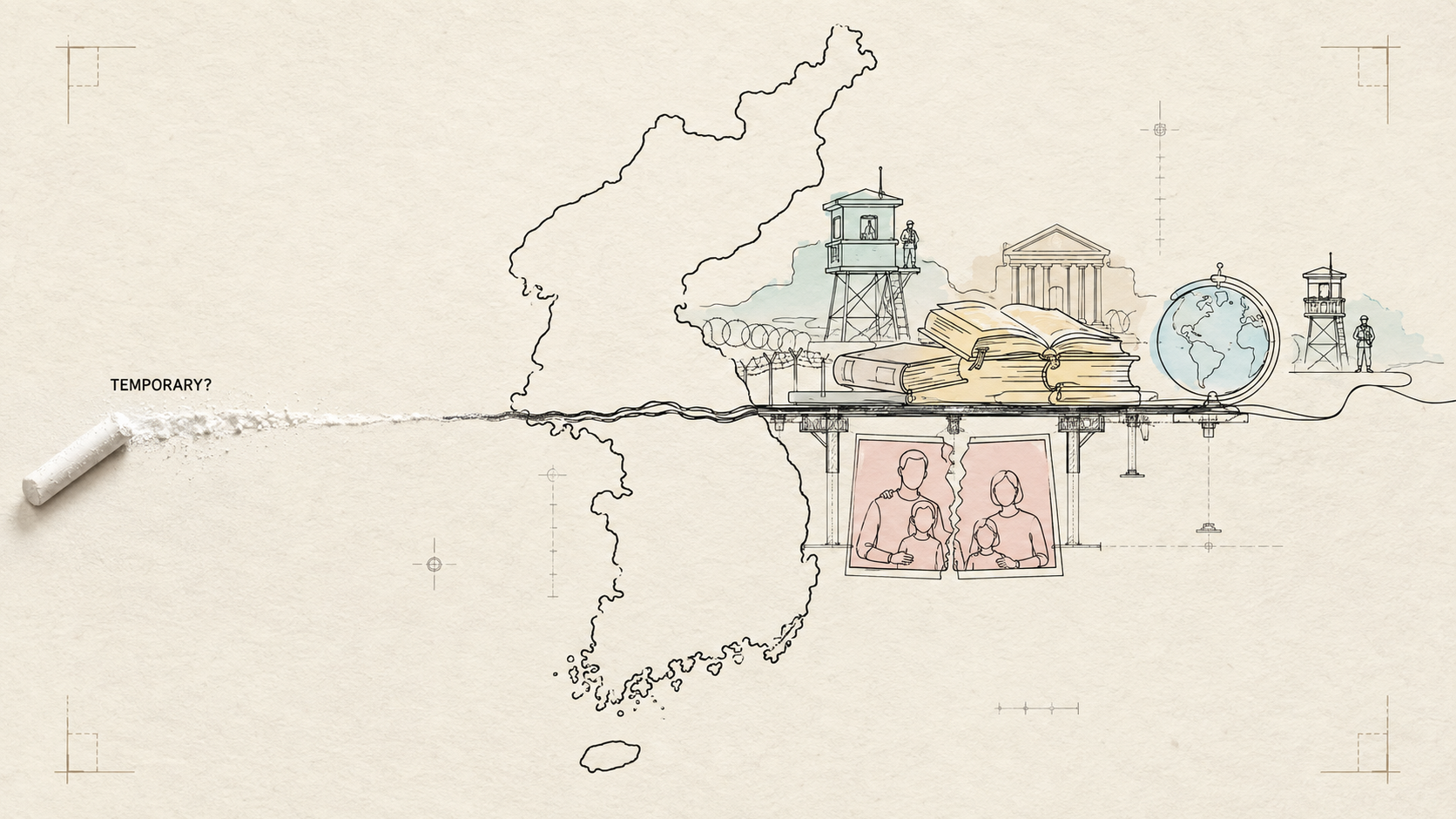
But a temporary arrangement changes what can happen next. North and south developed different administrations, police systems, political coalitions, currencies, and security institutions. Movement across the line became harder. In 1948, the Republic of Korea and the Democratic People's Republic of Korea were founded twenty-five days apart, each claiming a Korea larger than the territory it controlled.
One famous line hides three different things
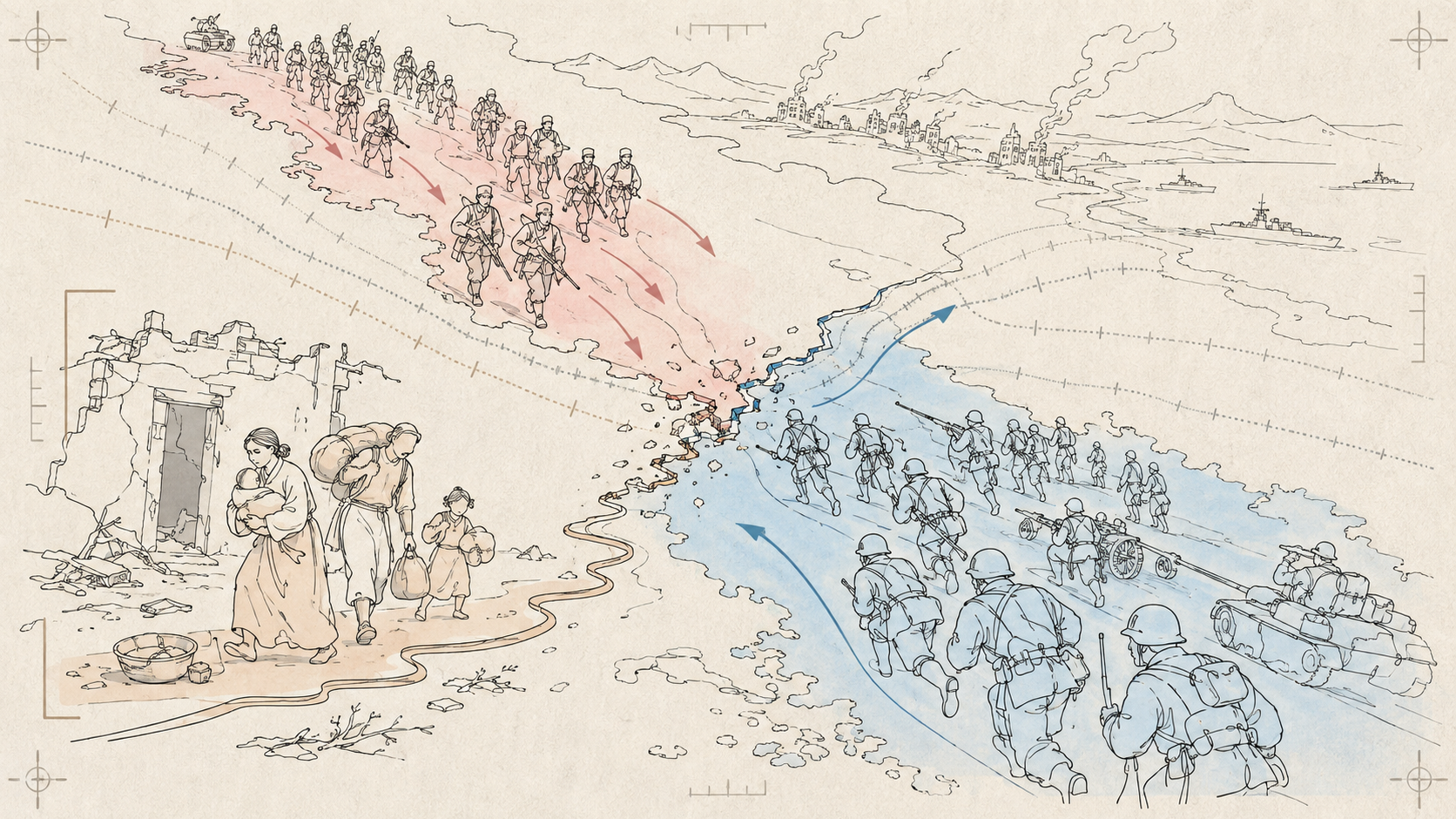
The 38th parallel was the 1945 occupation line. It is a line of latitude. It is not an accurate name for every boundary that followed. War began in June 1950 when North Korean forces invaded the South, and the front moved far below and far above the old parallel. When large-scale fighting stopped in 1953, the armies did not simply return to the original mark.
The armistice instead fixed a Military Demarcation Line, or MDL, close to the line of contact then occupied by the opposing forces. In some places the MDL lies north of the 38th parallel; in others it lies south. Around it sits the Demilitarized Zone, or DMZ, a buffer extending roughly two kilometers on each side. Despite its name, the DMZ is neither an empty nor an inherently peaceful space.
Then there is the armistice itself. An armistice stops fighting; it is not the same as a peace treaty that settles the political relationship. The Korean Armistice Agreement was signed on July 27, 1953, by commanders representing the Korean People's Army and Chinese People's Volunteers on one side and United Nations Command on the other. The Republic of Korea was not a signatory command, and President Syngman Rhee opposed the agreement.
The armistice halted large-scale hostilities, created the MDL and DMZ, and established machinery for supervising the truce. It did not turn the line into a mutually recognized permanent international border, and it did not reconcile the rival states. Saying "the line between the Koreas" without distinguishing these layers makes division look simpler and more inevitable than it was.
How the seam became load-bearing
Once each side of the damaged building has different wiring, removing the seam is no longer a matter of erasing chalk. Across divided Korea, the original arrangement became embedded in armies, alliances, constitutions, intelligence agencies, education, diplomacy, and personal memory. Each side often described its own actions as defensive while the other experienced them as threatening. A patrol produces a warning; a warning produces reinforcement; reinforcement confirms the original fear.
This is path dependence: the cost and meaning of a new choice depend on the path already taken. It does not mean change is impossible or that the outcome was automatic. It means a provisional rule can gain an enforcement office, a workaround can gain users, and an emergency boundary can gain guards until changing the original arrangement requires redesigning everything attached to it.
The past does not dictate the next choice. It changes what the next choice must confront.
Evidence needs handles
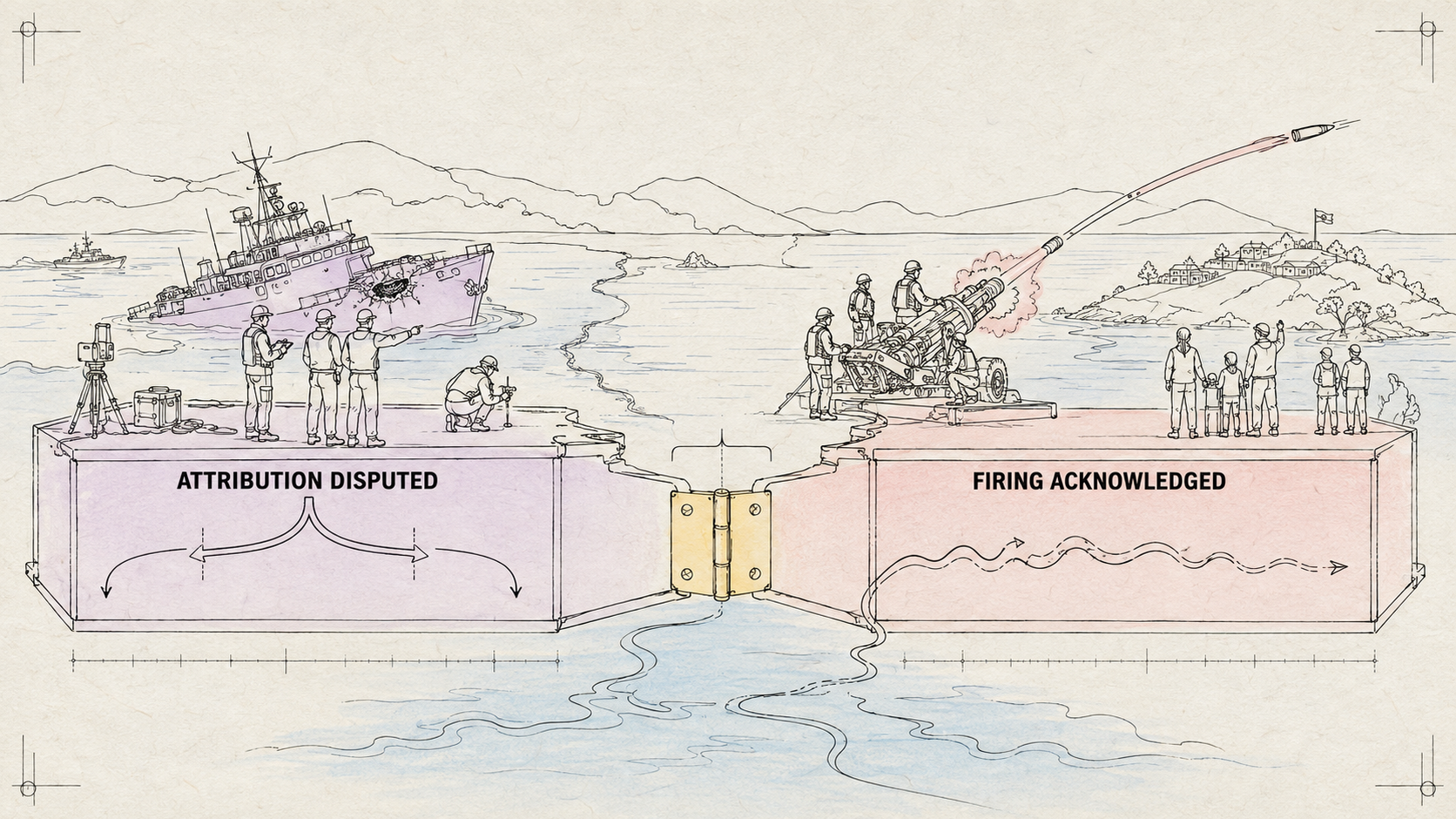
A fair chronology cannot be built by placing one accusation on each side of every paragraph and calling the result balanced. Different claims stand on different kinds of ground. A useful method is to mark a claim as established when it rests on an adjudicated finding or an admission by a responsible party; disputed when identifiable institutions or specialists reached competing conclusions; and alleged when an accusation was never adjudicated or officially confirmed. These are evidence labels, not moral scores.
Consider the 2010 sinking of the South Korean warship Cheonan, which killed forty-six sailors. A South Korean-led multinational investigation attributed the explosion to a North Korean torpedo. North Korea denied responsibility. China did not endorse the attribution, Russia never publicly endorsed it or released its expert report, and named specialists challenged parts of the forensic case. The United Nations Security Council statement condemned the attack and took note of the investigation, but did not name a perpetrator. Calling the attribution disputed preserves the shape of the evidence; it does not decide the case for the reader.
Compare that with the shelling of Yeonpyeong Island later the same year. North Korea acknowledged firing artillery. The dispute concerns the surrounding maritime conflict and the claimed sequence of events, not whether North Korean forces fired. The incidents occupy the same tense geography, but they do not belong in the same evidence category.
Chronology restores choices
When history becomes a montage of dramatic scenes, later assumptions leak backward. A film can make a disputed motive feel established; a national memory can make a temporary line feel ancient; a current alliance can make a past decision seem inevitable. Chronology restores what people could actually know and choose at each point.
The sequence contains more than hostility. The two governments issued a joint statement after secret contacts in 1972. In 1991, North and South Korea were admitted separately to the United Nations on the same day and signed a Basic Agreement describing their relationship as a special interim one arising from division. Summits in 2000 and 2018 briefly made the seam appear less rigid, while other periods closed channels or deepened military confrontation.
The systems on both sides kept changing. South Korea moved through authoritarian rule, mass protest, constitutional change, and democratic elections. North Korea consolidated a party-state under three generations of the Kim family and developed nuclear weapons. Division was not a frozen continuation of 1945; the structures attached to it evolved for decades.
The archive is part of the story
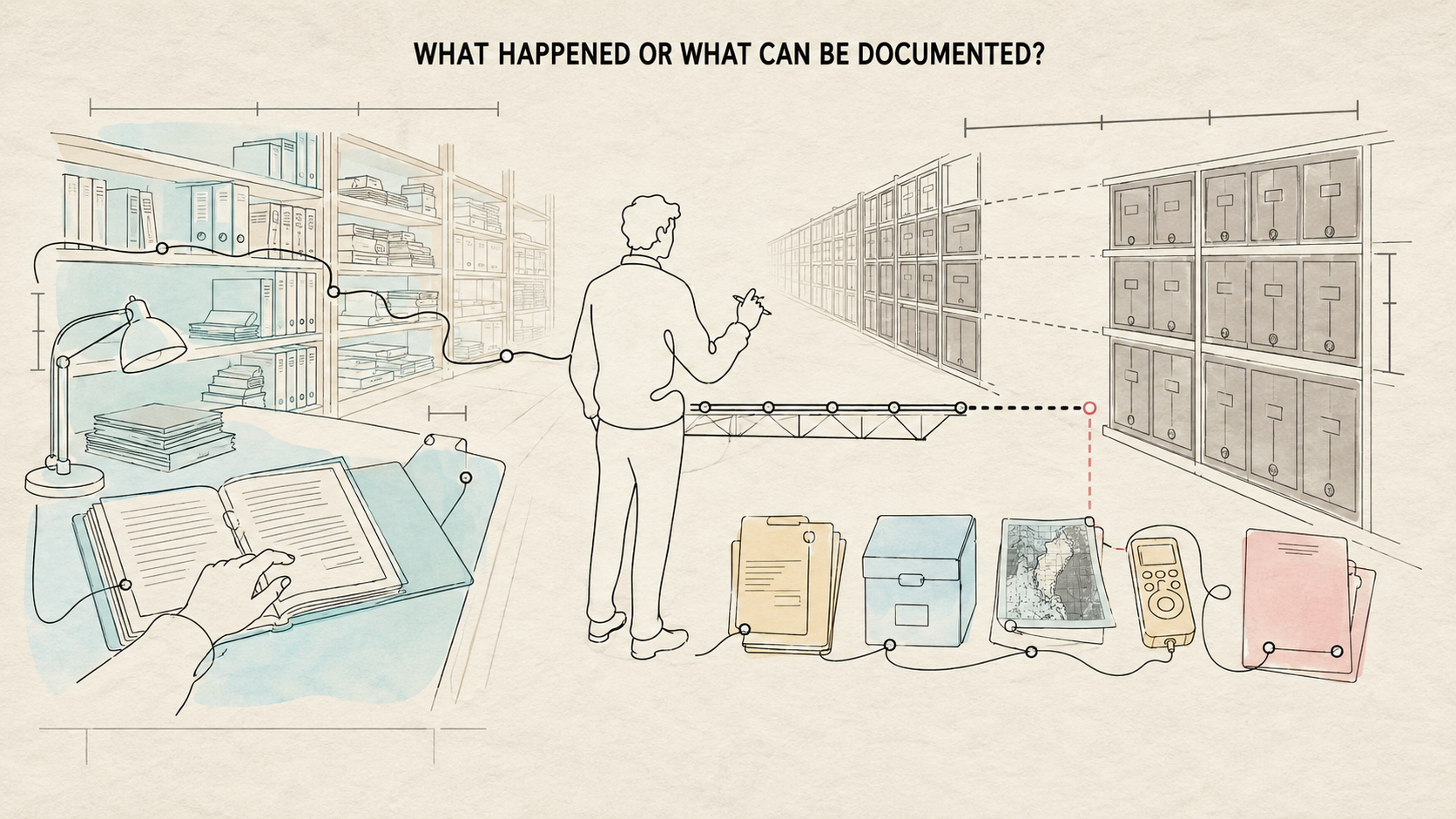
The surviving record is not evenly distributed. South Korea's archives, court decisions, legislative votes, press, and truth commissions expose more of its internal history, including abuses by earlier South Korean governments. North Korea's internal record is far less accessible. Some events can be reconstructed through official statements, foreign archives, satellite evidence, testimony, or other governments' records; other questions remain thin.
That imbalance creates a crucial reading question: are we seeing a difference in what happened, or a difference in what could be documented? More detail about one side may reflect more evidence rather than moral preference. Less detail about the other may reflect a closed archive rather than a clean record. Pretending the sources are symmetrical would not produce fairness; it would produce false confidence.
Where the seam metaphor stops
A seam cannot launch an attack, sign an agreement, censor a record, hold an election, or reopen a channel. People and institutions do those things. The metaphor explains why division is difficult to change; it must never become an excuse for treating later choices as inevitable or morally equivalent.
This is why "Why not just reunify?" begins at the wrong scale. The line is now attached to states with different legal orders, military alliances, economic systems, diplomatic relationships, and ideas of legitimacy. Likewise, saying the Koreas are "still technically at war" catches the unresolved armistice structure but can hide the fact that both are functioning states and separate UN members. The accurate picture must hold both realities at once.
Follow the full eighty-year chronology
Leo Wang's Eighty Years on the Line: A Neutral Chronicle of Divided Korea, 1945-2026 follows this path through wars and near-wars, regime changes, intelligence operations, secret channels, disputed events, and the distance between famous films and the documented record. It uses open sources, keeps contested claims visibly contested, and organizes the evidence so readers can form their own judgment. Read more or purchase it at ebook.wiki4what.com.
The line did not contain Korea's future. But once governments, armies, laws, and memories were built around it, every attempt to change the structure had to begin with what the line had come to carry. When a temporary arrangement lasts longer than most human lives, at what point does it become the reality every solution must start from?
Watch more first-principles field guides on Wiki4What, or read the essays at blog.wiki4what.com.